Launching a beauty brand, expanding a merchandising line, or curating a premium corporate gifting experience comes with a harsh supply chain reality: inventory minimums. For decades, overseas factories demanded orders of 5,000 to 10,000 units just to turn on the sewing machines. This forced emerging brands to either tie up massive amounts of capital in dead stock or settle for cheap, unbranded wholesale blanks that diluted their brand equity.
The manufacturing landscape has shifted. A genuine Low MOQ Cosmetic Bag Manufacturer bridges the critical gap between massive industrial requirements and rigid retail blanks. However, from our experience engineering retail-ready accessories at PrinteMbroideryBag, the term “customization” gets heavily manipulated by brokers at the 100-piece mark. Understanding exactly what structural, aesthetic, and material choices you have at low volumes is the difference between receiving a bespoke luxury accessory and a generic pouch with a crooked logo.
In this comprehensive guide, we will dissect the realities of low-volume production. We will explain not only what elements of a cosmetic bag can be tailored to your brand identity at 100 units, but whether specific customization routes are actually worth using, buying, or upgrading based on commercial viability.
Quick Answer: The 100-Piece Customization Reality
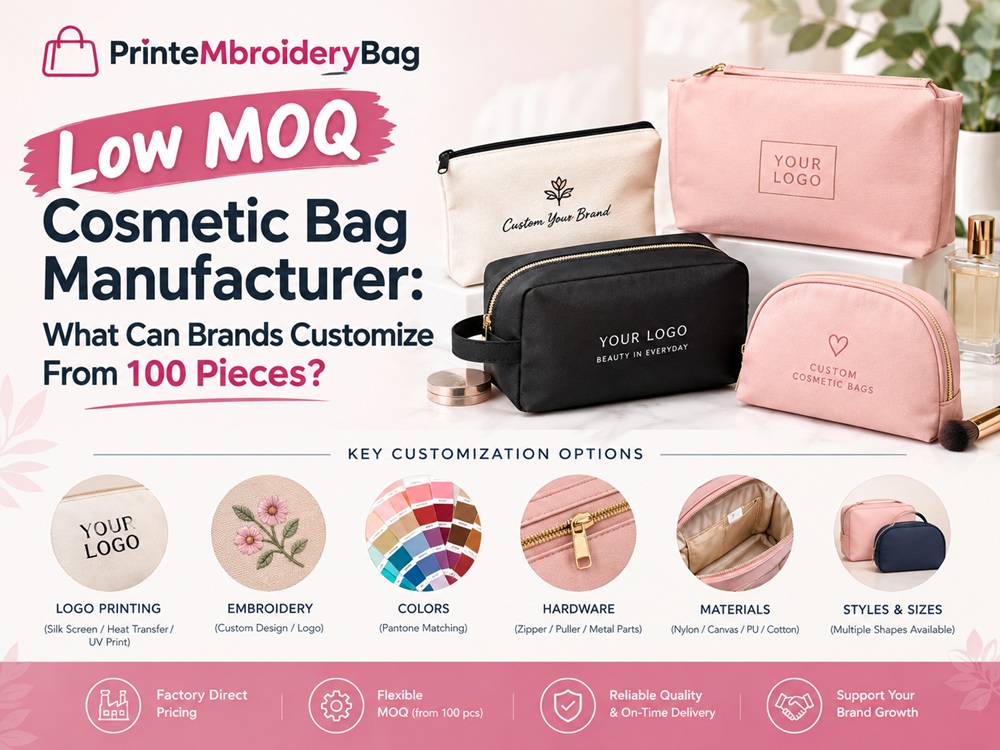
At an order volume of 100 pieces, a professional Low MOQ Cosmetic Bag Manufacturer allows you to fully customize surface-level branding and select from premium pre-existing structures. You can customize:
- Surface Decoration: Edge-to-edge printing, precise embroidery, or heat transfer logos on flat fabric panels before assembly.
- Fabric Selection: Choosing from extensive factory stock rolls (Canvas, PU Leather, Nylon, rPET).
- Labeling: Custom woven interior tags and exterior brand woven labels.
- Stock Hardware: Selecting zipper colors and standard puller shapes.
What you cannot do at 100 pieces: You cannot weave custom-dyed fabrics to an exact Pantone match (which requires 1000+ yards of milling), and you cannot mold custom zinc-alloy metal zipper pullers (which require expensive tooling). We recommend leveraging Custom Cosmetic Bags OEM100 programs that utilize proven base silhouettes while investing your budget into high-end decorative techniques.
Table of Contents
- What is a Low MOQ Cosmetic Bag Manufacturer?
- How Low-Volume Manufacturing Works
- What You Can Actually Customize
- Commercial Benefits of Low MOQ
- Limitations and Supply Chain Realities
- Pros and Cons Table
- Who Should Use It & Who Does Not Need It
- Comparison: 100 Pieces vs 5,000 Pieces
- Common Mistakes in Low MOQ Procurement
- Expert Buying Considerations
- Expert Recommendation
- Frequently Asked Questions (FAQ)
What is a Low MOQ Cosmetic Bag Manufacturer?
A Low MOQ (Minimum Order Quantity) Cosmetic Bag Manufacturer is a specialized production facility that has adapted its assembly lines, sourcing networks, and management protocols to handle small-batch runs efficiently. Unlike print-on-demand dropshippers who simply stamp logos onto pre-made bags, a true low MOQ manufacturer cuts, decorates, and stitches the bag specifically for your order.
This distinction is critical. If you buy a pre-made bag and send it to a local print shop, they cannot print near the seams or the zipper because the bag is already three-dimensional. A true manufacturing partner decorates the flat fabric panels before assembly, allowing for seamless, all-over Custom Printing Cosmetic Bags and complex Custom Embroidery Cosmetic Bags that signal high-end retail quality.
How Low-Volume Manufacturing Works
To produce only 100 pieces profitably, a factory relies on a modular, semi-custom supply chain. In most professional situations, the manufacturer maintains a massive library of high-quality “stock” fabric rolls in dozens of colors and materials.
When your order is placed, the factory selects the stock fabric, cuts it to the pattern of your chosen silhouette, and sends those flat panels to the decoration department. Once the ink cures or the embroidery is stitched, the panels move to the sewing floor where stock inner linings, zippers, and your custom woven labels are integrated. By utilizing stock fabrics and existing cutting dies, the manufacturer eliminates thousands of dollars in R&D and tooling setup costs, passing that efficiency directly to your brand.
What You Can Actually Customize at 100 Pieces
When assessing Cosmetic Bags Manufacturing Capabilities at the 100-unit tier, precision is key. Here is what is commercially viable:
1. Edge-to-Edge Decoration
Because the bag is built from scratch, your artwork can span the entire surface. If you are using cotton canvas, silk screen printing offers vibrant, durable colors. For complex, photorealistic designs on nylon or polyester, digital dye-sublimation transfers ink directly into the fibers, ensuring it never peels or cracks. For heavy-duty applications or luxury branding, high-stitch-count embroidery provides a tactile, premium finish that elevates the perceived value of the accessory.
2. Interior Linings
The inside of a cosmetic bag is just as important as the outside. Makeup spills are inevitable. At 100 pieces, you can specify water-resistant PU or rPET (recycled polyester) linings from stock colors to ensure the bag remains functional and easy to clean.
3. Private Labeling
A bag is not your brand until it carries your name. Low MOQ manufacturing allows for the inclusion of custom woven side-seam labels, interior printed tags, and branded hangtags. This transforms a generic product into a proprietary brand asset ready for retail shelves.
4. Retail Packaging
Presentation dictates pricing power. Integrating Packaging Solutions for Cosmetic Bags such as frosted CPE zipper bags, custom belly bands, or eco-friendly kraft boxes can easily be arranged even at smaller volumes, creating a frictionless unboxing experience for your customer.
Commercial Benefits of Low MOQ
The primary benefit of utilizing a Low MOQ Cosmetic Bag Manufacturer is extreme capital preservation. Tying up $15,000 in inventory for an untested product design is a catastrophic risk for a growing beauty brand. By ordering 100 pieces, you can test three different bag designs, gauge customer reaction, and pivot your strategy based on actual sales data without facing warehouse storage fees for dead stock.
Furthermore, it allows for highly targeted marketing. Brands can create limited-edition runs for seasonal promotions, influencer gifting PR packages, or exclusive VIP subscription box tiers.
Limitations and Supply Chain Realities
We must exercise commercial and practical judgment: 100 pieces is not 10,000 pieces, and the unit economics reflect that. The per-unit cost of a bag ordered at 100 pieces will be significantly higher than the same bag ordered at scale. A machine operator takes the same amount of time to set up a silk screen press for 100 bags as they do for 5,000. That setup labor is divided among fewer units, driving up the baseline cost.
Additionally, material science has physical minimums. If your brand guidelines require a highly specific, custom-dyed Pantone color for the raw canvas, you cannot achieve this at 100 pieces. Fabric mills require massive yardage minimums to run custom dye vats. At low volumes, you must compromise by selecting the closest matching stock fabric color.
Pros and Cons Table
| Pros (Advantages of Low MOQ) | Cons (Limitations of Low MOQ) |
|---|---|
| Requires minimal upfront capital investment, drastically reducing financial risk. | Higher per-unit cost reduces profit margins compared to bulk scaling. |
| Allows brands to A/B test multiple designs and colors in the real market. | Inability to custom-dye fabrics to exact brand Pantone matches. |
| Faster production turnaround times (typically 15-25 days). | Custom molded metal hardware (zipper pulls) is prohibitively expensive. |
| Eliminates the need for extensive warehouse storage space. | Restricted to pre-existing factory silhouettes and cutting dies. |
Who Should Use It & Who Does Not Need It
Who Should Use It: We recommend 100-piece production runs for indie beauty brands launching their first accessory line, subscription box curators needing exclusive seasonal add-ons, and corporate event planners requiring high-end, branded merchandise for executive retreats. It is the perfect entry point for testing the waters of Cosmetic Bags wholesale.
Who Does Not Need It: If you are a massive, established retail chain stocking hundreds of brick-and-mortar locations, ordering 100 pieces is a logistical waste of time. You require Full OEM Custom Cosmetic Bags production to achieve the economies of scale that drive major retail margins. Similarly, if your sole goal is acquiring the absolute cheapest bag possible (under $1.00), you do not need a custom manufacturer; you need to buy generic, unbranded stock off the shelf.
Comparison: 100 Pieces vs 5,000 Pieces
| Customization Metric | Low MOQ (100 Pieces) | High MOQ (5,000+ Pieces) |
|---|---|---|
| Fabric Color | Must select from factory stock colors. | Custom dyed to exact Pantone specifications. |
| Bag Structure / Silhouette | Limited to proven, existing factory patterns. | 100% bespoke; new patterns and molds created. |
| Hardware (Zippers/Pulls) | Stock shapes, standard finishes (gold, silver, black). | Custom 3D molded logos in any alloy finish. |
| Unit Cost Economics | Premium cost (absorbs higher setup labor). | Optimized cost (maximum economy of scale). |
| Turnaround Time | Rapid (2-4 weeks). | Extended (6-12 weeks for raw material sourcing). |
Common Mistakes in Low MOQ Procurement
Expert Insight: The most catastrophic mistake emerging brands make is attempting to design a highly complex, multi-material bag at a 100-piece volume.
Mixing genuine leather accents, waterproof TPU windows, and heavy canvas requires multiple specialized sewing machines and operator setups. At 100 pieces, the labor costs for complexity will instantly destroy your retail margin. Keep the structure simple and let the graphic decoration (the print or embroidery) carry the visual weight of the design.
Another frequent error is failing to provide vector artwork. Submitting a low-resolution JPEG for a screen print guarantees a blurry, unprofessional final product. Always supply artwork in AI, EPS, or high-res PDF formats.
Expert Buying Considerations
When vetting a Low MOQ Cosmetic Bag Manufacturer, demand transparency regarding their decoration capabilities. Do they print in-house, or do they outsource it? In our testing, factories that control the printing in-house deliver significantly higher quality control and faster sampling times.
Furthermore, assess their industry focus. A factory that primarily sews heavy-duty industrial luggage may lack the refined stitching techniques required for delicate velvet or satin cosmetic pouches. Look for suppliers embedded in the beauty and lifestyle sectors, as outlined in the Industries PrinteMbroideryBag Serve portfolio.
Expert Recommendation
Navigating the transition from concept to physical product requires a manufacturing partner that views small orders as the seed for long-term brand growth, rather than an operational nuisance. We strongly recommend seeking out structured low-MOQ programs designed specifically for this purpose.
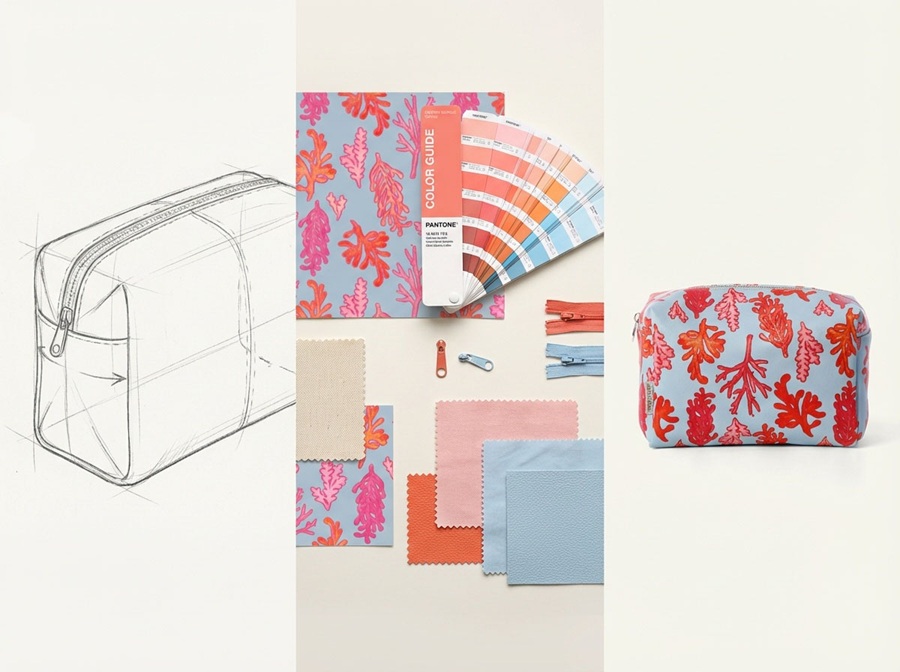
PrinteMbroideryBag – Create Completely Bespoke Cosmetic Bags
Our Specialization in Custom Cosmetic Bag Manufacturing: As an experienced custom cosmetic bag manufacturer, we specialize in transforming creative brand concepts into premium retail-ready cosmetic bags and accessories. From initial artwork development to final production, our team delivers customized solutions for design-led brands worldwide.
End-to-End Cosmetic Bag Development Expertise:
- Complex Product Development: We transform creative concepts into retail-ready cosmetic bags with strong visual appeal and functional structures.
- Artwork to Production: Our team converts brand ideas into professional print layouts, embroidery files, and detailed technical specifications to ensure accurate manufacturing.
- Advanced Decorative Techniques: We provide specialized craftsmanship including embroidery, precision color matching, and mixed-material combinations.
- Focused Collection Development: We support brands through sampling, design refinement, and production planning to build cohesive product lines efficiently.
- Complete Retail Presentation: We integrate product structures, inner linings, hardware components, labels, and packaging solutions to deliver a complete brand experience from factory to retail shelf.
Whether you are starting with our OEM100 program or scaling to massive Bags & Accessories wholesale distribution, we provide the engineering infrastructure to bring your vision to life.
Frequently Asked Questions (FAQ)
Does ordering a low MOQ mean the quality will be lower?
No. In most professional situations, a reputable manufacturer uses the exact same sewing machines, stock fabrics, and quality control standards for an order of 100 as they do for an order of 10,000. The only difference is the limitation on custom-molded hardware and custom fabric dyeing.
Should I ask for a sample before ordering 100 cosmetic bags?
Absolutely. We heavily advise commercial users to request a pre-production sample. While sampling incurs a nominal fee, it allows you to verify the fabric texture, print resolution, and zipper glide before committing to the full production run. Most factories apply the sample cost toward your bulk order.
Can I mix fabric colors within my 100-piece order?
Generally, no. The 100-piece minimum usually applies to one specific design and one specific colorway. Splitting the order into 50 black bags and 50 pink bags requires two separate production setups, which defeats the efficiency that allows the factory to offer the low MOQ in the first place.
How do I verify the factory is actually making the bags and not just reselling?
To verify a true manufacturer, check their About PrinteMbroideryBag or company profile. Request photos of their cutting and sewing floors, ask technically specific questions about print curing times, and look for their ability to customize interior linings, which dropshippers cannot do. For more details, consult the PrinteMbroideryBag FAQ.
Authoritative References & Industry Standards
To ensure our manufacturing methodologies align with global textile and trade standards, we adhere to guidelines set forth by the following authoritative organizations:
- Textile Exchange: Global non-profit organization establishing rigorous standards for preferred fibers, including the Global Recycled Standard (GRS) critical for sourcing sustainable rPET linings. Visit Textile Exchange
- U.S. Customs and Border Protection (CBP): Regulatory framework dictating textile import compliance, proper country of origin labeling, and tariff classifications for commercial cosmetic accessories. Visit U.S. Customs
- Pantone Color Institute: The globally recognized authority on color communication, establishing the precise color matching systems utilized in textile dye sublimation and screen printing. Visit Pantone