Every year, we watch ambitious beauty founders and retail merchandisers make the exact same twenty-thousand-dollar mistake: they approve a single, hand-sewn prototype sample in their office, fall in love with how it looks empty on a conference table, and immediately wire a deposit for 5,000 units to chase a lower unit cost. Eight weeks later, when the sea container arrives, reality hits hard. The zipper binds around the top corner radius when customers try to close it with one hand; the 150ml glass cleanser bottle is four millimeters too tall to sit upright inside the gusset; the pale sage colorway that looked trendy on a monitor sits dead in the warehouse while the terracotta version sells out in forty-eight hours; or the puffy quilted walls refuse to compress, doubling third-party logistics (3PL) pick-and-pack fees. Approving a single sample is not product validation. When you want to test a new cosmetic bag design properly, you must validate three things simultaneously: production-line sewing repeatability, real-world functional ergonomics, and actual consumer wallet commitment. At Printembroiderybags, we guide beauty brands from initial CAD patterns through agile 100-piece pilot runs to multi-thousand-unit retail programs daily. Here is our direct practitioner blueprint on how to test a new cosmetic bag design with a small minimum order quantity (MOQ), eliminating design flaws and dead-stock risk before you scale.
Direct Answer: What Is the Smartest Way to Test a New Cosmetic Bag Design?
To answer the product development intent directly: the smartest way to test a new cosmetic bag design is a three-stage “Prototype, Stress-Test, and 100-Unit Pilot” workflow that validates physical engineering and live customer sell-through before committing to custom fabric dye vats or 3,000-unit mass tooling.
From our experience running cut-and-sew production lines, a single pre-production sample (PPS) only proves that one master technician in a quiet sample room can assemble your bag once. It does not prove how bulk fabric behaves when stacked 30 plies high on a cutting table, nor does it prove whether shoppers will add the bag to their cart at a $38 retail price point. Instead of jumping from a 1-piece sample to a 3,000-piece gamble, we recommend executing a 100-to-300-unit small-MOQ pilot run using pre-qualified stocked base textiles combined with digital printing or computerized embroidery. This low-exposure pilot allows you to run A/B colorway split tests, catch assembly-line tension defects early, verify 3PL fulfillment packing speeds, and collect 30 days of real customer reviews—giving you empirical data to refine your “Golden Sample” before scaling into Full OEM mass production.
Quick Answer: The 6-Step Blueprint to Test a New Cosmetic Bag Design
When you need to test a new cosmetic bag design with minimal capital risk, follow this exact six-step factory validation sequence:
1. Perform a “Max-Bulk” Bottle Loadout Test: Load the physical prototype with your largest rigid bottles plus 15% finger-clearance allowance to catch zipper-pinch and gusset-bulge flaws.
2. Substitute Stock Base Fabrics for Custom Dye Vats: Avoid 2,000-yard mill minimums during testing by applying bespoke custom bag printing or embroidery onto factory-stocked performance polyesters, canvases, or vegan leathers.
3. Execute Destructive Bench Stress Testing: Subject 3 pilot bags to 200 rapid zipper cycles, a 48-hour liquid foundation spill test, and a 5 kg handle jerk test.
4. Run a 100-Unit Split-Colorway Pilot (OEM100): Produce 100 units per print or silhouette to audit real assembly-line stitch consistency and measure live e-commerce conversion rates.
5. Audit 3PL Fulfillment & Volumetric Shipping Costs: Test how the bag folds, nests, and packs inside outbound mailer boxes to prevent dimensional-weight freight penalties.
6. Engineer “Revision 2.0” Before Mass Scaling: Use customer unboxing feedback and factory QC data to adjust interlining stiffness or pocket widths before locking your 1,000+ unit OEM run.
Partnering with an engineering-driven manufacturer that offers both agile 100-unit pilots and full custom manufacturing ensures you never pay twice for tooling or get stuck with unsellable inventory.
Article Directory
- Direct Answer: What Is the Smartest Way to Test a New Cosmetic Bag Design?
- What It Is & How It Works: Single Prototyping vs. Small-MOQ Pilot Validation
- Quick Summary Table: The 6-Phase Small-MOQ Testing Framework
- 6 Practical Steps to Test a New Cosmetic Bag Design at 100 to 300 Units
- Manufacturer Spotlight: Printembroiderybags Full OEM & Agile Development
- Comparison Table: 3 Ways to Test a New Cosmetic Bag Design Compared
- Pros and Cons: Small-MOQ Pilot Runs vs. Traditional Mass Production
- Commercial Benefits and Technical Limitations of Small-Batch Testing
- Who Should Use Small-MOQ Design Testing vs. Who Does Not Need It
- 5 Costly Mistakes Brands Make When They Test a New Cosmetic Bag Design
- Buying Considerations, Cost-Benefit Analysis & Upgrade Recommendations
- Expert Recommendation: The Final Verdict on Validating Bag Designs
- Frequently Asked Questions
- Authoritative References & Textile Quality Standards
What It Is & How It Works: Single Prototyping vs. Small-MOQ Pilot Validation
In the cut-and-sew accessory industry, there is a massive operational gap between a sample-room prototype and assembly-line production. Understanding this gap is essential when you set out to test a new cosmetic bag design.
When you send a tech pack or sketch to a factory for an initial prototype, that single bag is built in the R&D sample room. A senior pattern maker cuts the fabric one ply at a time with laser scissors, and a master sample sewer spends two hours carefully feeding the gusset curves through a sewing machine, manually adjusting thread tension and steaming out every minor wrinkle. The resulting prototype looks flawless. However, when you place a mass order, your bag leaves the sample room and moves to the main production floor. There, fabric is stacked 40 layers high and sliced with a vertical reciprocating blade; twenty different operators handle discrete sub-assemblies (one stitches the zipper tape, one attaches the brush pockets, one binds the internal seams, and another turns the bag right-side out).
If a pattern has a tight 90-degree corner radius or uses a slippery satin lining paired with a heavy PU leather shell, those small tolerances compound across the assembly line, resulting in twisted gussets, wavy zippers, or needle perforations. A Small-MOQ Pilot Run (100 to 300 pieces) bridges this divide. It forces the design through genuine production-line cutting, bulk heat-press lamination, and multi-operator stitching while keeping your financial outlay minimal. At the same time, it gives your marketing team 100 to 300 retail-grade units to sell to real paying customers, turning your R&D expense into a revenue-generating market test. To see what standard silhouettes are available for immediate pilot testing, browse our cosmetic bags wholesale collection.
Quick Summary Table: The 6-Phase Small-MOQ Testing Framework
| Testing Phase | Primary Engineering / Market Focus | Batch Size Required | Pass / Fail Benchmark | Costly Failure Prevented |
|---|---|---|---|---|
| 1. Volumetric Fit Check | 3D gusset clearance & zipper mouth opening | 1 to 2 Paper/Muslin Mockups | Fits full routine + 15% hand clearance without zipper strain | Bags that are 5mm too short for hero skincare bottles |
| 2. Surface & Trim Audit | Print crocking, embroidery backing, hardware pull | 2 to 3 Pre-Production Samples | Zero ink rub-off; zero fabric puckering around stitches | Peeling screen prints & warped embroidered panels |
| 3. Destructive Lab Abuse | Seam slippage, zipper fatigue, oil/makeup staining | 3 Sacrificial Prototype Units | Survives 200 zip cycles, 5kg load, and 48-hr foundation spill | Burst corner zippers & permanently stained outer shells |
| 4. Production Line Pilot | Multi-ply cutting accuracy & sewing line repeatability | 100 to 300 Units (Small MOQ) | Passes AQL 2.5 inspection with <1% dimensional variance | Twisted boxy gussets on mass assembly lines |
| 5. 3PL & Freight Audit | Flat-pack compression, nesting, and mailer box fit | 1 Master Carton (20–50 Units) | Packs flat or nests cleanly without crease damage | Volumetric air/ocean freight overcharges |
| 6. Live Split-Test Drop | Conversion rate, AOV lift, and 30-day customer reviews | 100 Units per Colorway/Style | >60% sell-through in 30 days; <2% defect return rate | Ordering 5,000 units of an unpopular color or shape |
6 Practical Steps to Test a New Cosmetic Bag Design at 100 to 300 Units
1. Stress-Test Dimensional Gusset Allowances With Real Product Loadouts
The single most common mistake we see when brands test a new cosmetic bag design is approving dimensions based on flat 2D measurements. A brand founder measures a 180ml cleanser bottle that is 17cm tall and 5cm wide, and specifies a cosmetic pouch that is 18cm wide by 12cm high. When the sample arrives, the bottle cannot even enter the zipper mouth.
Why? Because a three-dimensional cylindrical bottle consumes diagonal gusset depth, and a standard top zipper opening is narrower than the total width of the bag due to the zipper stop ends. In our testing, we enforce the 20% Volumetric Clearance Rule:
- Before cutting expensive outer fabric, assemble your exact target product loadout (every bottle, palette, and brush the bag is meant to hold).
- Place those items inside a raw un-dyed muslin or Tyvek pattern mockup.
- Zip and unzip the bag ten times while fully loaded. Your hand must be able to reach the bottom of the bag without scraping your knuckles against the zipper teeth, and the side gussets must not bow outward into a strained football shape.
2. Audit Decorative Techniques Using Stock Fabrics to Bypass Mill Minimums
If you ask a textile mill to weave and vat-dye a custom Pantone shade of recycled nylon or cotton canvas, they will demand a minimum of 1,500 to 3,000 linear yards. That is enough fabric to make 8,000 bags—completely defeating your goal to test a new cosmetic bag design with a small MOQ.
In most professional situations, we recommend decoupling structural fabric from surface branding during your initial pilot run:
- For Printed Collections: Use the factory’s pre-qualified, stocked white or natural base fabrics (such as 600D polyester, RPET twill, or cotton canvas) and apply high-definition digital dye-sublimation or direct-to-film printing. This gives you 100% custom Pantone background colors and photographic patterns at a 100-piece minimum with zero screen setup charges.
- For Tactile Luxury Bags: Select from the factory’s stocked swatches of pebbled vegan leather, velvet, or washed canvas, and elevate the surface using our custom embroidered bags studio—applying 3D puff embroidery, chenille patches, or custom quilted stitch patterns.
This strategy gives your 100-unit pilot run the exact look and hand-feel of a custom-milled luxury line while keeping raw material lead times under seven days.
3. Execute Destructive Bench Testing on Zipper Radii, Interlining, and Linings
Do not treat your pre-production samples like fragile museum artifacts. To truly test a new cosmetic bag design, you must try to break it before your paying customers do. Whenever we develop a new silhouette in our sample room, we subject sacrificial prototypes to three real-world torture tests:
- The 200-Cycle Corner Zipper Torture Test: On boxy train cases, 180-degree lay-flat bags, and curved round pouches, the zipper slider must navigate tight 3cm to 4cm corner radii. Load the bag with 1.5 kg of weight and zip it open and closed 200 times rapidly at a 45-degree pulling angle. If the slider catches on the internal binding tape or the teeth separate at the corner curve, you must either widen the corner radius by 10mm, switch from metal teeth to a flexible #5 nylon coil zipper, or move the internal seam binding 3mm further back from the zipper track.
- The 48-Hour Liquid Foundation & Oil Spill Test: Smear liquid foundation, oil-based lip gloss, and micellar water onto the interior lining and let it sit for 48 hours. Wipe it with a damp cloth. If the oil bleeds through the stitch holes into the interlining foam or stains the exterior shell fabric, you must upgrade the interior to a PU-coated waterproof 210D polyester or heat-sealed TPU lining.
- The Crush-and-Recovery Interlining Test: Fold the empty bag flat under a 10 kg weight for 72 hours (simulating packed ocean freight cartons), then unpack it. If the bag remains permanently creased like crumpled paper, the factory used cheap paper greyboard or low-density foam. Upgrade the core to virgin polyethylene (PE) board or high-resilience cross-linked EPE/EVA foam paired with PVC keder piping.
4. Run a 100-to-300 Unit Split-Batch Pilot to Validate Assembly Repeatability
Once your destructive bench tests pass, place a pilot order of 100 to 300 units. This is where you test a new cosmetic bag design against both factory line dynamics and consumer psychology. Instead of ordering 300 identical black bags, split your pilot across two or three distinct variations—for example, 100 units in a bold botanical print, 100 units in a neutral quilted linen, and 100 units as a nested 3-piece bundle from our giftable cosmetic bag sets range.
During this 100-unit pilot run, our cosmetic bag quality assurance team monitors how the pattern performs on the sewing line. We track whether bulk rotary cutting shifts the print registration, whether needle heat melts synthetic coatings at high RPM, and how long each sewing station takes to complete the operation. Fixing a tight gusset seam after a 100-unit pilot costs pennies; discovering that same bottleneck during a 10,000-unit holiday run causes catastrophic delivery delays.
5. Audit 3PL Pick-and-Pack Ergonomics and Dimensional Freight Costs
A cosmetic bag design does not exist in a vacuum; it has to travel from the factory floor to your warehouse, and from your 3PL fulfillment racks to the customer’s front porch. Many brands design gorgeous rigid vanity cases, only to discover during their pilot launch that the bag is 1.5 centimeters too tall to fit into their standard e-commerce corrugated mailer box—forcing the 3PL to ship every order in an oversized carton that adds $4.20 in dimensional-weight postage per order.
Use your 100-unit pilot shipment to audit logistics economics:
- Master Carton Density: Measure how many units fit into a standard export carton ($60 \times 40 \times 40\text{ cm}$). Can a structured bag be engineered with a foldable Velcro bottom board so 60 units fit per carton instead of 16?
- Barcoding & Polybagging: Verify that your individual protective polybags have pre-printed FNSKU/UPC barcodes and suffocation warnings so your 3PL receiving dock can scan the pilot batch into inventory in minutes without charging manual re-labeling fees.
6. Harvest 30-Day Customer Feedback to Lock Your “Golden Sample”
The final phase when you test a new cosmetic bag design happens after your first 100 customers unbox the product. Track three hard commercial metrics over the first 30 days of live sales:
- Add-to-Cart & Bundle Attach Rate: When offered as a $28 standalone accessory or a $15 add-on to a skincare bundle, which colorway converts best?
- Functional Ergonomic Reviews: Survey the first 50 buyers. Did they wish the brush slots were wider? Did they love the wipe-clean pocket? Did they ask for a detachable wristlet strap?
- Return & Defect Rate: Any structural complaint exceeding 1.5% is an immediate engineering red flag.
Take those real-world insights, implement minor pattern tweaks (Revision 2.0), and lock that perfected bag as your signed “Golden Sample” for your 2,000-to-5,000-unit mass production scale-up.
Manufacturing Partner Spotlight: End-to-End Cosmetic Bag Development
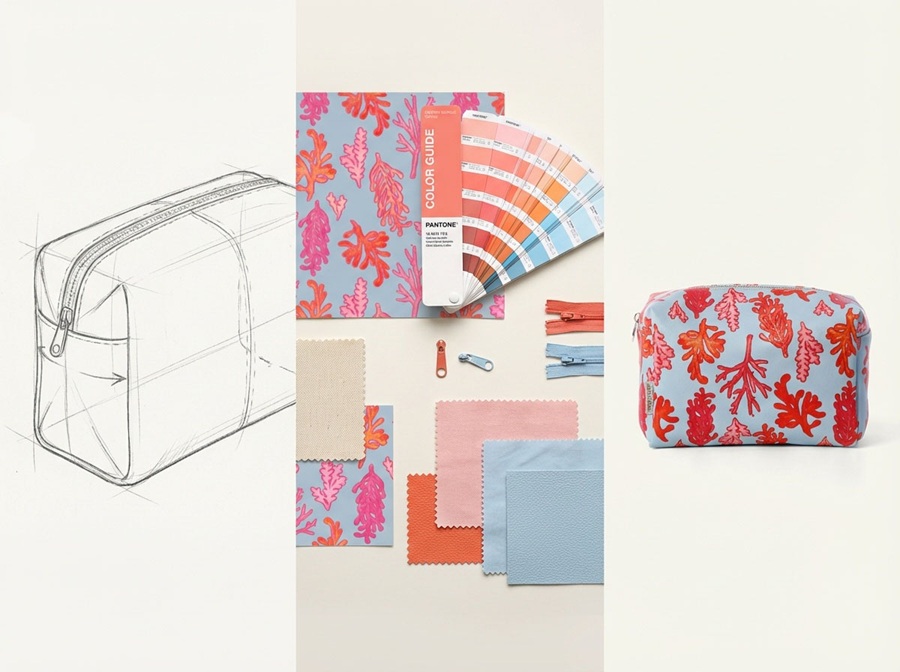
Whether you are running a 100-piece pilot test or scaling a flagship retail line, you need a factory partner capable of engineering your vision from initial sketch to retail shelf. As a premier Full OEM Development Cosmetic Cases manufacturer, Printembroiderybags transforms creative brand concepts into structurally superior, market-ready cosmetic bags and accessories.
| Artwork to Production | Converts brand concepts into precision CAD production drawings, print layouts, embroidery digitizing files, and detailed tech packs |
| Advanced Decorative Craft | High-definition digital/screen printing, multi-head embroidery, 3D appliqué, custom quilting, and mixed-material joinery |
| Focused Collection Testing | Supports brands through rapid prototyping, material selection, small-MOQ market validation, and mass production scaling |
| Complete Retail Presentation | Integrates custom inner linings, branded metal zipper pullers, woven labels, hangtags, and retail-ready packaging |
Product Developer’s Advice: Stop gambling on unverified trading brokers when developing new silhouettes. Inspect our full cosmetic bag manufacturing capabilities, compare regional R&D strengths in our guide to cosmetic pouch designers in China, or request a tailored pilot-run estimate via our custom cosmetic bag quote page.
Comparison Table: 3 Ways to Test a New Cosmetic Bag Design Compared
When brands decide to test a new cosmetic bag design, they typically choose between three validation models. Here is how they compare across cost, data accuracy, and commercial risk:
| Validation Parameter | Option A: Single Tech-Pack Prototype Only (1–3 pcs) | Option B: Small-MOQ Pilot Run (100–300 pcs) | Option C: Pre-Sale / Crowdfunding Before Tooling |
|---|---|---|---|
| Upfront Financial Outlay | $100 to $300 (Sample fee only) | $700 to $2,200 (Self-liquidating inventory) | $300 sample + Ad spend |
| Validates Assembly-Line Sewing? | No (Hand-sewn in sample room) | Yes (Proves multi-ply cutting & line flow) | No (Production risk happens after pre-sale) |
| Validates Real Customer Buying Intent? | No (Internal team opinions only) | Yes (Live e-commerce conversion & reviews) | Yes (Pre-order wallet commitment) |
| Validates 3PL & Freight Economics? | No (Shipped in a single DHL envelope) | Yes (Tests master carton density & mailer fit) | No (Discovered too late during fulfillment) |
| Time to Market / Feedback Loop | 7 to 14 days (No market data) | 15 to 20 days production + Immediate sales | 60 to 90 days (Customers wait months) |
| Our Practitioner Verdict | Necessary first step, but dangerous to scale from directly | The Gold Standard for Retail & DTC Brands | High customer refund risk if factory delays hit |
Pros and Cons: Small-MOQ Pilot Runs vs. Traditional Mass Production
| Production Strategy | Commercial & Engineering Advantages (Pros) | Operational Limitations & Trade-Offs (Cons) |
|---|---|---|
| Small-MOQ Pilot Run (100–300 Units) (Agile Validation First) | Caps total financial risk under $1,000 to $2,500 per SKU. Catches assembly-line sewing and zipper defects before mass scaling. Allows live A/B testing of 2 to 3 print patterns or colorways. Generates organic UGC unboxing content and verified buyer reviews. Fast 15-to-20-day turnaround keeps seasonal launch calendars agile. | Unit cost is 20% to 35% higher than 5,000-piece mass volume pricing. Must utilize stocked base fabrics rather than custom-milled yarn weaves. Custom-molded metal zipper puller dies require amortizing over future runs. |
| Blind Mass Production (3,000–5,000+ Units) (Skipping the Pilot Run) | Lowest theoretical unit cost on the factory quotation sheet. Unlocks custom vat-dyed fabrics and bespoke jacquard linings immediately. Amortizes custom metal hardware mold fees across thousands of units. | Ties up $15,000 to $40,000+ in unproven inventory for months. Any unspotted ergonomic flaw (like a narrow zipper mouth) ruins 5,000 units. High 3PL pallet storage fees if sell-through is slower than forecasted. 8-to-14-week production and sea-freight timeline misses viral trends. |
Commercial Benefits and Technical Limitations of Small-Batch Testing
When you test a new cosmetic bag design with a 100-to-300-unit pilot run, you shift power back to your balance sheet. However, experienced product managers must understand both what a small-MOQ test unlocks and what technical limitations still apply at 100 units.
The Tangible Commercial Benefits
- Self-Liquidating R&D: Traditional market research focus groups cost $5,000 and only tell you what people say they like. A 150-unit pilot run costs ~$1,200, and when sold on your Shopify store at $32 per bag, generates $4,800 in gross revenue—paying for your entire R&D phase while proving what customers actually buy.
- Zero-Risk Retail Buyer Pitching: If you are pitching retail buyers at specialty beauty chains or department stores, walking into the meeting with a single fragile sample and no sales data is weak. Walking in with a polished production unit from a 200-piece pilot run—backed by data showing the bag sold out online in 14 days with a 4.9-star rating—closes wholesale purchase orders immediately.
- Elimination of “Version 1.0” Warranty Disasters: Every iconic bag needs minor tweaks after real users pack it. Small-batch testing lets you quietly fix a stiff zipper or widen an interior pocket on unit #101 instead of issuing refunds on 5,000 defective bags.
The Technical Limitations at 100 Units
- Custom Mill-Dyed Fabric Restrictions: At 100 to 300 bags, you only consume 40 to 120 yards of fabric. Textile mills cannot run a custom Pantone vat-dye bath for 50 yards without charging a $600 to $1,000 dye-vat surcharge. Therefore, during a small-MOQ test, you must either select from the factory’s extensive book of stocked fabric colors or use digital printing to achieve custom hues.
- Custom Molded Hardware Amortizations: Opening a custom steel mold for a bespoke 3D zinc-alloy zipper puller costs $250 to $450. While you can certainly open that mold during a 100-unit pilot (and keep the mold on file for your mass run), it adds $2.50 to $4.50 per bag if amortized solely over the first 100 units.
Who Should Use Small-MOQ Design Testing vs. Who Does Not Need It
Who Should Always Test with a Small-MOQ Pilot Run
- For Beginners & Emerging Indie Beauty Founders: If you are launching your first custom makeup bag, skincare travel kit, or holiday bundle, never commit more than 15% of your working capital to unvalidated packaging inventory.
- For Commercial Users & Established DTC Brands Launching New Silhouettes: Even if your brand sells 50,000 units a year, whenever you introduce a radically new mechanical structure—such as moving from a simple flat pouch to a 180-degree accordion bag or a double-decker train case—a 200-unit pilot test validates customer ergonomics and 3PL packing speed before you roll it out storewide.
- Subscription Box & Seasonal Drop Curators: Brands that release limited-edition monthly or quarterly prints need fast, 100-to-300-unit validation batches to identify runaway bestsellers before placing deep holiday restocks.
Who Does Not Need Small-MOQ Pilot Testing
- Repeat Re-Orders of Proven Core Silhouettes: Once you have already validated a cosmetic bag structure and sold through your initial pilot run cleanly, ordering in 100-piece increments is no longer cost-effective; step up to 1,000–3,000 units to capture full volume discounts.
- Contract GWP Programs with Locked Retail Distribution: For heavy-duty applications where a major retail partner has already issued a binding purchase order for 10,000 promotional Gift-With-Purchase pouches on a proven, simple flat-pouch pattern, a thorough Pre-Production Sample (PPS) and inline AQL inspection are sufficient without a separate retail pilot run.
5 Costly Mistakes Brands Make When They Test a New Cosmetic Bag Design
Factory Engineer’s Warning: The “Empty Bag Approval” Trap
The number one mistake we see product managers make when they test a new cosmetic bag design is evaluating the sample while it is stuffed with crisp factory tissue paper. Tissue paper weighs nothing and exerts uniform outward pressure, making even a poorly patterned bag look symmetrical and boxy. The moment a real customer removes the tissue paper and drops a heavy glass foundation bottle and two metal-ferrule brushes inside, an un-reinforced bag sags in the middle, tips forward on the counter, and buckles along the zipper track. Throw the tissue paper in the trash immediately—always test and photograph your sample loaded with its actual, heaviest intended cosmetic bottles.
- Changing Multiple Variables Between the Pilot Run and Mass Production: A brand runs a successful 100-unit pilot using a 600D polyester shell with 3mm EPE foam backing, then tries to shave $0.40 off the mass-production order by switching to a cheaper 300D fabric and 1.5mm foam without re-sampling. The mass-production bags arrive floppy and cheap-looking, triggering customer complaints that the bag doesn’t match early influencer videos. Never downgrade structural materials after a pilot test without running a new Pre-Production Sample.
- Testing Artwork on RGB Monitors Instead of Physical Fabric Strike-Offs: Approving a custom print pattern based on a glowing smartphone screen. Sublimation and pigment inks react differently depending on whether the base fabric is shiny nylon, matte cotton canvas, or textured vegan leather. Always demand a physical printed fabric swatch (“strike-off”) before running your 100-unit pilot.
- Ignoring Zipper Tape Shrinkage During Heat Lamination: When fabrics are laminated to foam or heat-transferred with digital prints, thermal exposure can cause the fabric panel to shrink by 1.5% to 2%, while the nylon zipper tape does not shrink—resulting in a wavy, “bacon-rippled” top zipper track. Experienced manufacturers pre-shrink printed panels before cutting and sewing.
- Failing to Test Interior Pocket Elastic Tension: Designing interior elastic brush loops or bottle holders that are either so tight they crush brush bristles, or so loose that lipliners slip straight through to the bottom of the bag. Test every single elastic slot with your actual physical SKU dimensions.
- Using a Trading Company That Switches Sub-Factories Between Pilot and Bulk: Many trading brokers farm your 100-piece test order out to a small local workshop, and then move your 3,000-piece bulk order to a completely different rural factory that uses different sewing machines, different interlining glues, and different thread tensions. Always audit your partner using our cosmetic bag supplier audit checklist to ensure both pilot and bulk runs happen under the same quality management system.
Buying Considerations, Cost-Benefit Analysis & Upgrade Recommendations
When preparing to test a new cosmetic bag design, smart procurement managers evaluate factory partners and material upgrades through a commercial cost-benefit lens:
1. Factory Quality Standards & Testing Protocols to Demand
Even on a small 100-to-300-unit pilot order, your manufacturer must enforce formal industrial quality standards:
- Random Batch Inspection (ISO 2859-1 / AQL 2.5): Demand that your pilot batch is inspected under ISO 2859-1 Acceptable Quality Limit (AQL) Sampling Procedures, checking stitch density (typically 8 to 10 stitches per inch), symmetrical gusset alignment, and loose thread trimming.
- Mechanical Hardware Strength (ASTM D2061): Zipper sliders and teeth must meet cross-wise and pull-off strength baselines defined by ASTM D2061 Standard Test Methods for Strength Tests of Zippers.
- Chemical & Consumer Safety Compliance: All outer coatings, PVC/TPU windows, and metal zipper pullers must comply with lead and phthalate restrictions enforced by the U.S. Consumer Product Safety Commission (CPSC).
2. Cost-Benefit Analysis: The 100-Unit Pilot vs. The 3,000-Unit Gamble
Let us look at the real numbers. Suppose a complex cosmetic bag costs $6.50 per unit at a 100-piece pilot MOQ ($650 total), versus $4.20 per unit at a 3,000-piece mass MOQ ($12,600 total).
Beginners often obsess over that $2.30 unit price gap. However, if you sell that bag at a $28.00 retail price during your pilot test, you still earn a massive 76.7% gross margin ($21.50 profit per bag) at the 100-piece price—while risking only $650 of cash. Once the first 100 units sell out and validate the design, you place your 3,000-unit order at $4.20 with 100% confidence, expanding your gross margin to 85%. Paying $230 more across the first 100 units is the cheapest insurance policy in the retail industry against $12,600 of dead stock.
3. High-Impact Upgrade Recommendations for Your Pilot Run
When you test a new cosmetic bag design, we recommend testing one or two low-cost premium upgrades that dramatically lift perceived retail value:
- Upgrade #1: Custom Woven Damask or Silicone Interior Labels ($0.12–$0.25/unit): Even if you use a stocked exterior fabric for your 100-unit test, sewing a crisp custom woven brand label inside the lining and a small flag label into the exterior side seam makes the bag look 100% bespoke.
- Upgrade #2: Piping-Reinforced Gussets ($0.20–$0.35/unit): Adding PVC keder piping along the outer seams keeps the bag standing tall and structured in customer unboxing photos, boosting social media shareability.
- Upgrade #3: Water-Repellent TPU Wipe-Clean Pocket ($0.30–$0.50/unit): Adding a single frosted TPU zippered pocket inside the lid for wet sponges or leaky travel bottles consistently earns 5-star functional reviews from buyers. For more material and construction tips, explore our cosmetic bag manufacturing blog.
Expert Recommendation: The Final Verdict on Validating Bag Designs
From our experience engineering and manufacturing custom cosmetic bags for startups and global beauty houses alike, our verdict is uncompromising: never scale a new cosmetic bag silhouette to mass production without running a 100-to-300-unit small-MOQ pilot test first. A single hand-made sample tells you how a bag looks on your desk; a 100-unit pilot run tells you how the bag survives the factory floor, the 3PL warehouse, and the customer’s bathroom counter.
Here is the exact action plan we recommend:
- Build & Abuse Your Physical Prototype: Load the sample with your heaviest bottles, cycle the zipper 200 times around the corners, and test the lining against oil and foundation spills.
- Launch a 100-Unit Split-Test Pilot: Use stocked base fabrics paired with our custom digital printing or embroidery to launch 100 units per colorway in 15 to 20 days—keeping your upfront investment under $1,500 while generating immediate retail revenue.
- Refine and Scale with Printembroiderybags: Because Printembroiderybags operates both an agile 100-piece customization program and a full-scale OEM development factory under one roof, you never have to switch vendors after a successful test. Contact our engineering team today to start your prototype and validate your next bestselling cosmetic bag with total confidence.
Frequently Asked Questions
Why is a single prototype sample not enough to test a new cosmetic bag design?
A single sample-room prototype is sewn by a master sample maker taking two hours to align every seam by hand. It does not reveal how the fabric behaves under multi-ply cutting knives, how zipper tape puckers on an assembly line, or whether actual retail customers will pay for the colorway. A 100-to-300-unit small-MOQ pilot run validates both factory production consistency and real-world market sell-through.
What is the ideal order quantity to test a new cosmetic bag design?
In most professional situations, 100 to 300 pieces per colorway is the sweet spot. An order of 100 units is large enough to run on an actual modular sewing line and collect statistically meaningful e-commerce conversion data, yet small enough to keep total financial exposure under $800 to $2,000.
How do you test cosmetic bag durability before scaling to mass production?
Before scaling past a pilot batch, subject the bag to five physical checks: a 200-cycle corner zipper pull test, a 5-kilogram static handle load test, a 48-hour oil-and-foundation interior lining stain test, a 3PL carton compression test, and an actual bottle-loadout volumetric fit check.
Can you test custom prints and embroidery on a small 100-piece MOQ?
Yes. By utilizing high-definition digital dye-sublimation printing and computerized multi-head embroidery onto pre-qualified stock fabrics rather than custom-milled textiles, beauty brands can test full-bleed custom patterns and raised 3D embroidery at 100 pieces without paying thousands in rotary cylinder or dye-vat setup fees.
Authoritative References & Textile Quality Standards
- International Organization for Standardization (ISO): ISO 2859-1 Sampling Procedures for Inspection by Attributes – Acceptable Quality Limit (AQL) Lot Inspection Plans
- ASTM International: ASTM D2061 Standard Test Methods for Strength Tests of Zippers, Slider Lock Retention, and Cross-Wise Tape Load
- U.S. Consumer Product Safety Commission (CPSC): Regulatory Compliance Guidelines for Lead, Phthalates, and Mechanical Hardware in Consumer Bags and Accessories