Every beauty brand founder, retail merchandise director, and corporate purchasing manager eventually learns the hard way that a cosmetic pouch is not just a promotional giveaway. It is an intimate daily touchpoint for your end consumer. When a customer pays seventy dollars for a luxury skincare regime or an artisanal cosmetics kit, packaging those products inside a cheap, flimsy stock polyester bag with a crooked heat-transfer logo cheapens the entire brand experience. Worse yet, low-tier bags suffer catastrophic failures in the field: zipper teeth misalign and jam after two weeks, unsealed seams bleed leaking foundation onto designer luggage, and cheap interior PVC backings off-gas unpleasant chemical odors. Transitioning to Full OEM Cosmetic Bag Development is the definitive step that separates serious beauty labels from hobbyist market resellers. True OEM manufacturing is not about browsing a catalog of generic blanks and slapping a screen print on the front. It is an end-to-end industrial cut-and-sew engineering discipline that transforms raw two-dimensional vector artwork, textile science, and structural architecture into a retail-ready, branded accessory. As master textile craftsmen who calibrate embroidery stitch densities, engineer waterproof laminate barriers, and run automated sewing lines daily, we present the comprehensive blueprint for executing Full OEM Cosmetic Bag Development without costly sampling mistakes, factory delays, or compromised brand equity.
Quick Answer: What Is Full OEM Cosmetic Bag Development?
Full OEM Cosmetic Bag Development is a custom, factory-direct manufacturing process where an original beauty bag or vanity case is engineered entirely from scratch to a brand’s exact mechanical specifications. Unlike white-label or ODM sourcing, full OEM development controls seven critical production phases: (1) Tech Pack & 2D/3D CAD Pattern Creation (defining exact physical dimensions, seam allowances, gusset profiles, and volumetric capacity); (2) Material Selection & Substrate Chemistry (sourcing custom-milled cotton canvas, vegan PU leather, ripstop nylon, or TPU with water-resistant EVA/PVC backing); (3) Custom Color & Embellishment Engineering (matching Pantone shades via reactive digital printing, rotary wet printing, or multi-head embroidery using Madeira threads); (4) Hardware & Zipper Customization (specifying pull-force ratings, electroplated metal finishes, and nylon coil versus metal teeth); (5) Prototyping & Golden Sample Sign-Off (verifying stitch density, structural balance, and lining fit); (6) Mass Die-Cutting, Stitching & In-Line Assembly (utilizing automated CNC knife tables, walking-foot industrial machines, and reinforced bound seams); and (7) AQL 2.5 Quality Control, Needle Detection & Custom Packaging. Manufacturers like Printembroiderybags make this level of custom development accessible through programs like their Custom Cosmetic Bags OEM100 service, enabling luxury-grade bespoke production starting at just 100 sets.
Article Directory
- What Full OEM Development Really Means: Engineering vs. White-Labeling
- Quick Summary Table: The 7 Stages of Full OEM Cosmetic Bag Development
- Step-by-Step OEM Roadmap: From Vector Artwork to Mass Production
- Featured OEM Craftsmanship: Lavender Toile Printed Ruffled Cosmetic Bag
- Direct Technical Comparison: Full OEM Custom vs. Ready-Stock ODM vs. Off-the-Shelf Wholesale
- Commercial Benefits vs. Operational Limitations of Full OEM Development
- Pros and Cons Table: Sourcing Full OEM Cut-and-Sew Manufacturing
- Who Needs Full OEM Development vs. Who Can Settle for Stock Blanks
- Costly Sourcing & Construction Mistakes Beauty Brands Make
- Essential Factory Sourcing Checklist: SPI, Needle Testing & Certifications
- Expert Manufacturing Practitioner’s Final Verdict
- Frequently Asked Questions
- Authoritative Textile References & Quality Standards
What Full OEM Development Really Means: Engineering vs. White-Labeling
To master Full OEM Cosmetic Bag Development, brand managers must discard the illusion that ordering promotional bags is as simple as ordering custom t-shirts. A t-shirt is a pre-knitted, pre-assembled garment onto which a print is applied. A cosmetic bag is a complex, three-dimensional, multi-layered structural container subject to continuous mechanical stress, abrasion, interior chemical exposure, and dynamic packing loads.
When an enterprise engages in Full OEM Cosmetic Bag Development, every single element of the product is bespoke:
- The Outer Shell Substrate: Dictates the visual, tactile, and structural identity of the pouch. Whether selecting a heavy 16oz organic cotton canvas, water-resistant twill, crinkle nylon, buttery vegan PU leather, or biodegradable TPU, the fabric’s weight (GSM), weave density, and coating must balance softness with upright structural rigidity.
- The Interlining and Structural Stiffeners: A bag that collapses into an unsightly, shapeless pile on a bathroom vanity looks cheap. Professional OEM construction deploys tailored internal layers: non-woven fusible interlinings, closed-cell EVA foam (2mm to 4mm thickness) for impact-cushioning fragile glass serum bottles, or polyethylene piping inserts along perimeter seams to maintain crisp architectural shape.
- The Interior Barrier Lining: Cosmetics leak. Serums, liquid highlighters, and micellar waters contain oils and alcohol solvents that dissolve low-grade glues and stain outer fabrics. OEM development integrates wipe-clean, leak-proof linings such as 210D polyester coated with PU, food-grade EVA, or antimicrobial coatings that protect the outer shell from internal accidents.
- Closure Architecture: Zippers endure thousands of cycles over a bag’s lifespan. OEM development allows you to engineer custom zipper specifications: selecting between #3, #5, or #8 nylon coil, chunky resin, or electroplated metal teeth; pairing them with zinc-alloy pullers stamped with your debossed logo; and calculating zip-opening clearances so makeup brushes slide in without catching on the slider.
From our experience on the cutting room floor, skipping this structural engineering and relying on off-the-shelf blanks limits your brand to generic dimensions that rarely fit standard makeup palettes, resulting in awkward proportions and disappointed consumers. Full OEM production gives you complete sovereignty over form, function, and aesthetic prestige.
Quick Summary Table: The 7 Stages of Full OEM Cosmetic Bag Development
| Production Stage | Primary Technical Activity | Key Engineering Deliverables | Typical Phase Timeline | Critical Failure Prevented |
|---|---|---|---|---|
| 1. Tech Pack & CAD Design | Translating design concept into mechanical patterns | 2D flat pattern grading, cut-sheet dimensions, BOM | 3 – 7 Days | Proportion errors, makeup brushes not fitting interior |
| 2. Substrate & Lining Sourcing | Milling custom shell fabrics, linings, and foam cores | Fabric GSM verification, Pantone lab dips, water tests | 7 – 14 Days | Flimsy structure, color mismatch, chemical odors |
| 3. Embellishment Engineering | Executing custom embroidery, printing, or quilting | Embroidery strike-offs, digital reactive print runs | 5 – 10 Days | Puckering around embroidery, print crocking/rub-off |
| 4. Hardware Customization | Die-casting custom pullers, plating zipper tracks | Custom mold tooling, electroplated metal samples | 7 – 12 Days | Zipper teeth splitting, pull-tabs snapping under torque |
| 5. Golden Sample Sign-Off | Hand-crafting first physical prototype for approval | Complete sealed golden sample, physical audit sheet | 5 – 7 Days | Mass production executing flawed patterns at scale |
| 6. Bulk Cutting & Assembly | CNC fabric cutting, synchronized walking-foot stitching | Batch assembly runs, in-line seam reinforcement | 15 – 25 Days | Loose thread ends, irregular seam margins, crooked labels |
| 7. QA, Needle Testing & Packing | AQL 2.5 final inspection, metal detection, packaging | Inspection audit reports, barcoded retail polybags | 3 – 5 Days | Broken sewing needle fragments shipped to retail clients |
Step-by-Step OEM Roadmap: From Vector Artwork to Mass Production
Stage 1: Technical Tech Pack Creation & CAD Pattern Engineering
The journey of Full OEM Cosmetic Bag Development begins not with fabric, but with a comprehensive technical specification sheet (Tech Pack). If you provide a cut-and-sew factory with an inspirational mood board or a flat JPEG rendering, the sample maker is forced to guess seam allowances, gusset curves, and internal compartment depths. A professional Tech Pack removes all ambiguity.
Your technical design file must define:
- Exact Volumetric Dimensions: Height, width, base depth, and top zipper opening length, factoring in internal seam allowances (typically 0.8cm to 1.2cm).
- Bill of Materials (BOM): Documenting exact specifications for outer shell fabric, interior lining, interlining foam, piping cords, thread weight, zippers, pullers, woven brand labels, and care tags.
- Internal Architecture: Specifying elasticated brush loops, mesh zip pockets, removable acrylic dividers, or magnetic closures.
- Construction Callouts: Detailed cross-section diagrams showing French seams, bound seams, edge paint thicknesses, and reinforcement bar-tacks at high-stress zipper terminal points.
At Printembroiderybags, our pattern makers import these specifications into computerized CAD pattern systems, generating precision cut-files that guarantee symmetrical panels across every production unit. For an overview of how we structure our production lines, explore our Cosmetic Bags Manufacturing Capabilities.
Stage 2: Substrate Sourcing, GSM Validation & Waterproof Laminations
Once the pattern is digitized, raw material procurement begins. Fabric selection directly governs the bag’s hand-feel, durability, and retail price point. A brand targeting an eco-conscious demographic may specify a heavy 12oz GOTS-certified organic cotton canvas, while a luxury cosmetics house might demand a saffiano-grain vegan PU leather or a waterproof ripstop nylon.
During this stage, textile engineers conduct rigorous material validation:
- GSM (Grams per Square Meter) Verification: Verifying that delivered fabric rolls meet the specified density standard, ensuring the material will not feel thin or saggy.
- Lab Dip Color Approvals: Formulating custom dye recipes to match your target Pantone Matching System (PMS) color codes under standardized D65 daylight viewing booths.
- Water-Resistant Coating Application: Applying internal backing layers. In most professional situations, we recommend a secondary lamination of Ethylene Vinyl Acetate (EVA) or Thermoplastic Polyurethane (TPU) onto the reverse side of the shell or lining. Unlike traditional PVC backings that turn stiff and crack in winter temperatures, TPU and EVA remain soft, flexible, completely odorless, and 100% waterproof. Reviewing our curated Products for Custom Cosmetic Bags showcases how various substrates behave under dynamic use.
Stage 3: Embellishment Execution: Precision Printing vs. Luxury Embroidery
This is where your vector graphic artwork transforms into a tactile, branded reality. In Full OEM Cosmetic Bag Development, embellishment is applied to flat, un-sewn pattern panels before the bag is stitched together. This flat-panel approach ensures graphics can bleed edge-to-edge, run seamlessly across zipper seams, and wrap around rounded corners without distortion—something completely impossible when attempting to print onto pre-made stock bags.
Depending on your brand identity, you must select the appropriate embellishment technology:
- Custom Printing Methodologies: For vibrant photographic prints or intricate botanical motifs, modern factories deploy rotary screen printing, digital direct-to-textile (DTG) reactive printing, or dye sublimation. Sourcing through specialized Custom Printing Cosmetic Bags facilities ensures that inks penetrate deep into natural cotton fibers, passing ASTM crocking tests to ensure patterns will not flake, bleed, or rub off when exposed to cosmetic oils or friction.
- Precision High-Density Embroidery: For luxury lifestyle, bridal, and heritage aesthetics, embroidery delivers unmatched physical texture and perceived retail value. High-speed multi-head embroidery machines utilize computerized digitizing software to convert your artwork into precise stitch paths. Using premium high-tensile polyester or rayon threads (such as Madeira or Isacord), embroidery craftsmen build satin stitches, tatami fill stitches, and 3D puff embroidery. When executing Custom Embroidery Cosmetic Bags, the key engineering challenge is stabilizing the backing: applying the correct non-woven tear-away stabilizer to prevent the embroidery needle from puckering the surrounding fabric.
Stage 4: Hardware Engineering, Zippers, and Puller Customization
Nothing ruins a luxury cosmetic pouch faster than a sticky, low-grade zipper. The zipper is the primary mechanical moving part on the bag. If an end consumer has to fight the zipper slider around the corner curves of a structured vanity case, their perception of your brand plummets immediately.
During OEM hardware development, engineering teams configure every component:
- Zipper Gauge and Style: Sourcing heavy-duty #5 nylon coil zippers for flexible cosmetic pouches (providing smooth, continuous glide around curves without catching) or #5 brass/metal teeth with electroplated finishes (light gold, gunmetal, rose gold, matte black) for rigid, structured vanity trunks.
- Custom Metal Pullers: Designing bespoke zinc-alloy pull tabs featuring your brand’s engraved, embossed, or cut-out logo. The puller must pass strict pull-force tensile testing (minimum 20 to 30 kgf of lateral tension) to ensure it will never snap off the slider body under heavy opening torque.
- Corrosion-Resistant Electroplating: Ensuring all metal hardware—including D-rings, slider buckles, and logo plates—undergoes electroplating with a protective clear lacquer coating, passing 24-to-48-hour salt spray testing to prevent green verdigris oxidation in humid bathroom environments.
Stage 5: Prototyping, Fitting Audits & The Golden Sample Sign-Off
Never authorize mass production without inspecting and physically testing a complete pre-production prototype: the Golden Sample. The golden sample is the definitive physical benchmark against which every single production unit will be measured and judged on the assembly line.
When the sample arrives at your brand headquarters, conduct a comprehensive physical audit:
- Volumetric Capacity Test: Load the sample with your actual beauty products: lipstick tubes, compact palettes, serum dropper bottles, and brushes. Does the top zipper close smoothly without straining the seam stitching?
- Stitch Density & Seam Integrity: Check the Stitches Per Inch (SPI). High-end commercial cosmetic bags mandate 7 to 9 SPI using heavy-duty nylon-bonded threads. Loose, spaced-out stitching (4 to 5 SPI) indicates rushed, low-cost assembly prone to seam slippage.
- Lining Fit & Excess Fabric: Inspect the interior corners. The lining must sit flush against the outer shell. If the lining pattern was drafted too large, baggy folds of excess fabric will bunch inside the pouch, catching in the zipper teeth every time the user opens the bag.
Once all dimensional, tactile, and aesthetic parameters are verified, the brand director and factory quality manager physically sign and date two identical golden samples: one remains in your brand archives, and one hangs on the master production board on the factory sewing floor.
Stage 6: Mass Die-Cutting, Stitching Assembly & In-Line Quality Control
With the golden sample approved, mass production begins. The process starts on the cutting floor, where rolls of fabric are spread onto long vacuum tables. Industrial automated CNC oscillating knife cutters or hydraulic clicker presses cut thousands of fabric panels with laser precision, ensuring every panel matches the master CAD cut-file to within a fraction of a millimeter.
From the cutting room, panels move across specialized sewing lines organized in sequential stations:
- Station 1: Embellished front and back panels are prepped with fusible interlinings and EVA foam layers.
- Station 2: Inner slip pockets, elastic organizers, and brand woven labels are stitched to the interior lining panels.
- Station 3: The zipper tape is stitched between the outer shell and interior lining using specialized zipper-foot industrial machines, ensuring uniform margins.
- Station 4: Gusset panels and base panels are joined using heavy-duty walking-foot sewing machines, with perimeter seams enclosed inside durable grosgrain or polyester binding tape to eliminate exposed raw fabric edges.
- Station 5: High-stress stress points—such as the top ends of the zipper and side grab handles—receive automated cross-box or bar-tack reinforcement stitching to resist tearing under heavy dynamic loads.
Throughout assembly, roving Quality Control (QC) inspectors audit seam margins, thread tension, and symmetry across every station, immediately pulling off-spec units before they reach final packaging.
Stage 7: Quality Assurance, Needle Detection & Custom Packaging
The final phase of Full OEM Cosmetic Bag Development separates professional, export-grade manufacturing plants from uncertified cut-and-sew workshops. Before any cosmetic bag is packed into shipping cartons, it must pass through two non-negotiable safety and quality checkpoints.
First, every single finished bag must pass through an automated conveyor metal detector (Needle Detection Machine). In commercial sewing environments, fine sewing needles occasionally break. If a microscopic metal needle tip breaks off and lodges inside an interior seam, it poses a severe liability hazard for the consumer. Passing 100% of finished bags through calibrated electromagnetic needle detectors guarantees that no broken needle fragments enter retail distribution.
Second, certified quality auditors conduct a final statistical inspection adhering to ANSI/ASQ Z1.4 (ISO 2859-1) AQL 2.5 Major / 4.0 Minor sampling standards. Auditors evaluate cosmetic appearance, zipper glide torque, thread trimming, dimensional tolerances, and barcode scannability. Finally, bags are stuffed with tissue paper to preserve their three-dimensional shape, packed into protective polybags, and boxed inside heavy-duty 5-ply corrugated export master cartons lined with silica gel desiccant packs to prevent moisture absorption during ocean transit. Sourcing comprehensive Packaging Solutions for Cosmetic Bags ensures your products arrive uncrushed, pristine, and ready for immediate retail display.
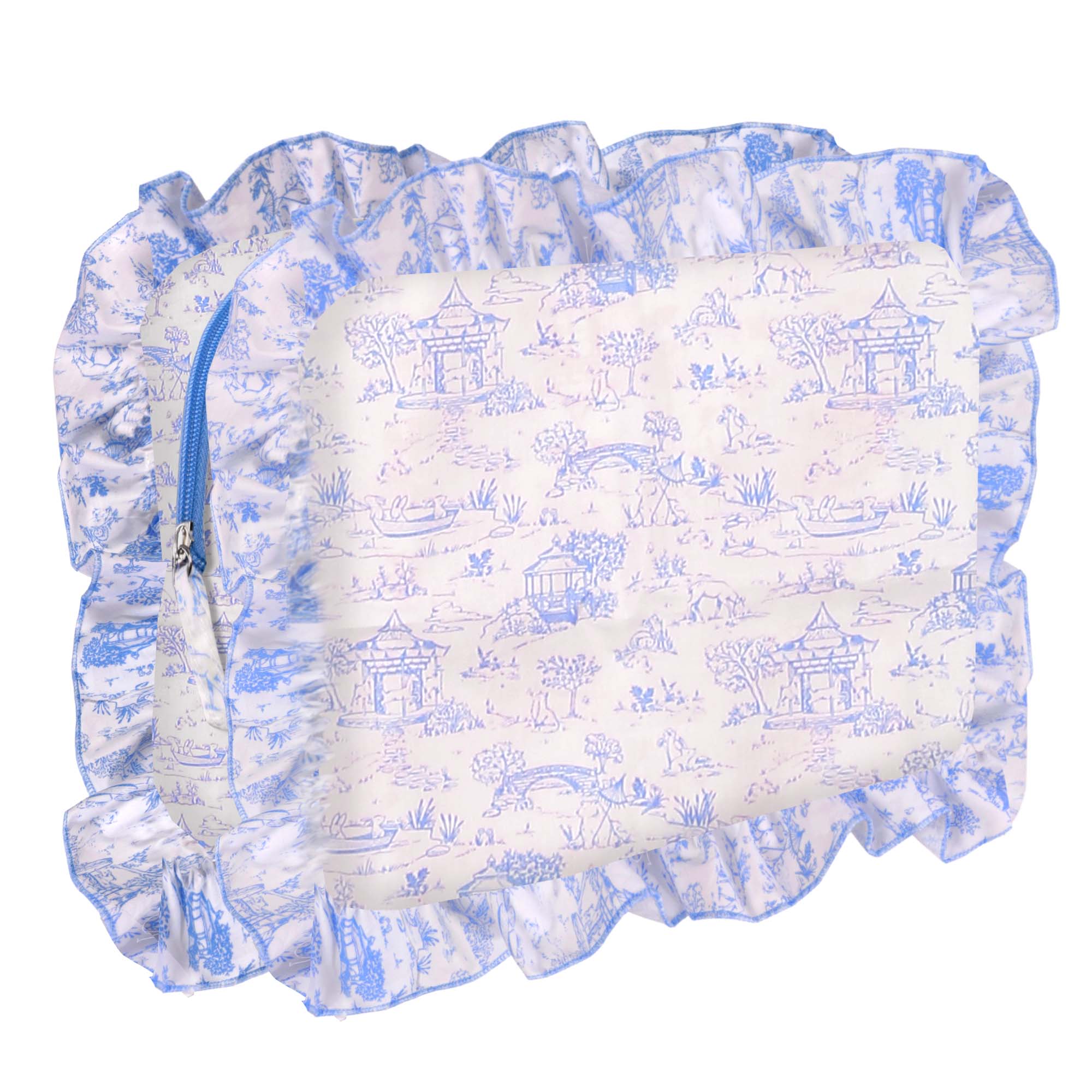
OEM Craftsmanship Spotlight: Lavender Toile Printed Ruffled Cosmetic Bag
Demonstrating the sophisticated multi-stage capabilities of Full OEM Cosmetic Bag Development, this bespoke vanity pouch pairs intricate European-inspired toile printing with tactile, high-density floral embroidery and feminine ruffled seam edging.
| Available Dimensional Sizing | Style 20201: 7.5 × 3.0 × 4.7 inches | Style 20202: 7.5 × 2.7 × 5.5 inches |
| Textile Construction | 100% Premium Natural Cotton Shell with soft structural interlining and wipe-clean interior |
| Embellishment Architecture | All-over custom Lavender Toile reactive print paired with raised Leaf & Floral embroidery (Yellow / Orange / Blue) |
| Structural Craftsmanship | Gathered ruffled perimeter edge trims, reinforced nylon zipper glide, custom metal puller |
| Production Flexibility | Accessible commercial entry starting at an agile 100 Sets MOQ; packaged 12 sets per inner carton |
Sourcing Guidance: Explore the full construction details on the Lavender Toile Printed ruffled edges cosmetic bag product portal, or discover broader catalog inspiration across our Cosmetic Bags wholesale and Bags & Accessories wholesale collections.
Direct Technical Comparison: Full OEM Custom vs. Ready-Stock ODM vs. Off-the-Shelf Wholesale
| Development Metric | Full OEM Custom Development (Bespoke Cut & Sew) | Ready-Stock ODM Customization (Logo on Stock Shape) | Off-the-Shelf Commodity Wholesale (Blank Inventory) |
|---|---|---|---|
| Design & Silhouette Exclusivity | 100% Proprietary (Unique dimensions, pockets, curves) | Partial (Pre-existing factory shape, custom print/color) | Zero (Identical commodity blanks sold to all competitors) |
| Fabric & Substrate Selection | Complete (Custom GSM, organic canvas, vegan PU, TPU) | Limited (Must select from factory’s available inventory) | Fixed (Pre-sewn cheap polyester or basic nylon) |
| Embellishment Scope | Unlimited (Edge-to-edge printing, 3D embroidery, quilting) | Restricted (Small centered print/patch on pre-sewn bag) | None (Requires third-party local post-production printing) |
| Hardware & Zipper Branding | Custom-molded zinc pullers, dyed-to-match zipper tapes | Standard factory pullers; optional laser logo engraving | Generic unbranded low-grade zinc or plastic pullers |
| Minimum Order Quantity (MOQ) | 100 sets (via Printembroiderybags OEM100) to 1,000+ pcs | 50 to 200 pieces per colorway | 10 to 50 pieces per carton |
| Development Lead Time | 8 to 12 Weeks (From CAD pattern to final delivery) | 3 to 5 Weeks (Sampling to warehouse dispatch) | 1 to 2 Weeks (Immediate catalog shipping) |
| Gross Margin Potential at Retail | Exceptional (75% to 88% retail margin profile) | Moderate (55% to 70% retail margin profile) | Low (High competition, price-sensitive commodity) |
Commercial Benefits vs. Operational Limitations of Full OEM Development
The Proven Commercial Benefits:
- Uncompromised Brand Defensibility: In a hyper-competitive beauty market, a proprietary bag silhouette cannot be reverse-searched on wholesale portals by your customers. Your shape, colorways, and lining prints are completely unique to your enterprise.
- Maximized Retail Perceived Value & Profit Margins: A stock promotional bag feels like a freebie; a fully customized OEM vanity case constructed with textured cotton, piped seams, and custom-engraved metal hardware commands $35 to $65 at retail, yielding gross margins exceeding 80%.
- Tailored Ergonomics for Product Collections: If you are selling an 8-piece beauty collection, full OEM development allows you to engineer internal compartments that fit your exact dropper bottles, mascara wands, and eyeshadow palettes with zero rattling or glass collision.
- Cleanroom Quality and Regulatory Compliance: OEM production guarantees that fabrics, dyes, and coatings meet strict international chemical safety standards, ensuring zero lead, phthalates, or toxic formaldehyde odors touch your consumer’s personal care products.
The Inherent Operational Limitations:
- Longer Initial Development Cycles: You cannot rush structural engineering. Designing patterns, cutting tooling dies, dyeing custom fabric lots, and approving physical golden samples requires planning 2 to 3 months in advance of holiday or product launch dates.
- Upfront Capital Commitment: While agile programs like our OEM100 service lower the barrier to entry, full OEM development requires committing capital for initial prototype sampling, custom zipper mold tooling, and bulk production runs.
- Demands Clear Technical Specifications: OEM manufacturing requires active brand collaboration. If your team cannot define dimensions, pick Pantone colors, or approve material swatches decisively, development timelines will stall.
Pros and Cons Table: Sourcing Full OEM Cut-and-Sew Manufacturing
| Operational Parameter | Commercial Advantages (Pros) | Operational Limitations & Risks (Cons) |
|---|---|---|
| Customization & Aesthetics | Complete control over dimensions, materials, and colors. Edge-to-edge printing applied before panels are sewn. Custom electroplated metal hardware with branded logos. Seamless alignment with seasonal brand visual guidelines. | Requires providing high-resolution vector artwork files. Design revisions after tooling dies are cut incur extra costs. |
| Economics & Supply Chain | Direct factory pricing eliminates 30% to 50% broker markups. High product durability eliminates customer return claims. Lower per-unit cost at scale compared to customizing stock blanks. | Longer lead times than pulling pre-made blanks from a warehouse. Requires managing ocean freight or express air logistics schedules. |
Who Needs Full OEM Development vs. Who Can Settle for Stock Blanks
Every dollar allocated to packaging procurement must deliver an operational return. Full OEM Cosmetic Bag Development is a high-yield investment for specific commercial tiers, but it is not necessary for every promotional use case.
Who Must Invest in Full OEM Cosmetic Bag Development:
- Direct-to-Consumer (DTC) Beauty & Skincare Brands: If you are retailing premium cosmetic kits, subscription boxes, or seasonal holiday gift sets, the cosmetic bag is part of the core product. Delivering a bespoke, high-end bag elevates perceived value, drives unboxing shares on social media, and justifies premium price points.
- Luxury Fashion Houses & Boutique Accessories Labels: Brands whose reputation rests on impeccable textile craftsmanship, intricate embroidery, and distinctive aesthetics require custom fabric sourcing, bound seams, and bespoke hardware that match high-fashion standards. Explore creative directions in our gallery of custom embroidered bags.
- Corporate Hospitality, Spas & High-End Event Merchandisers: Luxury resort spas and elite corporate brands providing executive gifts demand bespoke vanity cases that reflect their institutional prestige, completely free from generic promotional merchandise aesthetics. Review target sectors in our breakdown of Industries PrinteMbroideryBag Serve.
Who Can Settle for Off-the-Shelf Stock Blanks:
- Short-Notice Promotional Trade Show Giveaways: If your company needs 1,000 inexpensive tote bags or pencil pouches in ten days to hand out free pens at a medical conference, full OEM development makes no sense. Sourcing pre-made commodity blanks with a basic single-color pad print is the logical commercial choice.
- Early-Stage Startups with Sub-$500 Budgets: If you are testing a brand concept with negligible startup capital, paying for custom pattern drafting and custom fabric dyeing is financially impractical. Test your market demand first before committing to bespoke production.
Costly Sourcing & Construction Mistakes Beauty Brands Make
Factory Floor Advisory: The single most expensive mistake beauty brands make in OEM development is designing internal bag dimensions around the exterior product packaging instead of the actual cosmetic containers. A cosmetic jar may fit on paper, but when you factor in 1cm interior seam allowances, bulky zipper tape overhang, and foam interlining, the bag will not close. Always prototype with physical cosmetic products inside the sample.
- Approving Pre-Production Samples on Digital Monitors Only: Never sign off on mass production based on a digital 3D rendering or high-resolution photograph. Digital screens do not show whether the zipper slider catches on internal lining fabric, how the cotton canvas feels against human skin, or whether the bag balances upright on a flat surface when loaded with heavy glass bottles. Always touch and test a physical golden sample.
- Ignoring Zipper End-Stop Reinforcements: In cheap bags, the zipper ends are simply sewn directly into the side seam with a standard single stitch. When a consumer tugs hard to zip a packed bag, the zipper slider pulls right off the track, or the fabric seam rips open. High-stress OEM engineering requires double bar-tack stitching or reinforced fabric zipper tabs at both terminal ends of the zipper tape to absorb opening stress.
- Specifying Low-Grade Interior Linings with Zero Liquid Barriers: Lining a cosmetic bag with untreated 100% raw cotton sounds eco-friendly, but the moment a liquid foundation bottle shatters or a lotion cap pops off during air transit, the liquid saturates the unlined cotton, bleeds through the foam core, and permanently stains the outer embroidered shell. Always specify an internal wipe-clean TPU or EVA water-resistant barrier.
- Skipping Broken Needle Detection Audits: In uncertified cut-and-sew workshops, high-speed sewing needles break frequently when passing through thick multi-layer seams. If an operator fails to find the broken needle tip and continues sewing, that sharp metal fragment remains hidden inside the lining. When your retail customer reaches inside the bag and cuts their finger, your brand faces immediate product liability lawsuits and retailer boycotts. Settle for nothing less than 100% conveyor needle detection testing.
- Neglecting Comprehensive Supplier Factory Audits: Sourcing through unverified online trading intermediaries leaves you vulnerable to subcontracting scams, child labor violations, and unauthorized material substitutions. Always audit prospective suppliers using a structured cosmetic bag supplier audit checklist before wiring manufacturing deposits.
Essential Factory Sourcing Checklist: SPI, Needle Testing & Certifications
Before issuing a formal Purchase Order or transferring a production deposit for Full OEM Cosmetic Bag Development, enforce written technical confirmation across these four non-negotiable manufacturing benchmarks:
1. Stitch Density and Seam Construction Standards
Mandate an operational stitch density of 7 to 9 Stitches Per Inch (SPI) across all exterior and structural seams using bonded polyester or continuous filament nylon threads. Demand that all raw internal fabric edges be encased within durable grosgrain or polyester binding tape, preventing thread fraying and unraveling inside the pouch throughout years of washing and friction.
2. Certified Non-Toxic Chemical Compliance
Ensure your supplier’s raw materials, masterbatch dyes, and water-resistant coatings comply with international chemical safety regulations:
- EU REACH & RoHS: Certified free from Substances of Very High Concern (SVHC), including harmful azo dyes, toxic heavy metals (lead, cadmium), and restricted endocrine-disrupting phthalates.
- California Proposition 65: Verifiable documentation proving that exterior PU leather, PVC trims, and interior coatings fall comfortably below statutory reproductive toxicity and cancer exposure limits.
3. Hardware Pull-Force and Salt Spray Validation
Require documented mechanical test reports for metal zippers and custom pullers. The zipper teeth must withstand a minimum crosswise tensile breaking strength of 450 to 600 Newtons (under ASTM D2061 standards), and the metal pull-tab must endure 200 Newtons of lateral tension without separating from the slider body. Inquire about salt spray corrosion resistance (minimum 24 hours ASTM B117) to prevent bathroom humidity tarnishing.
4. Flexible Low-MOQ Tiered Scaling
Look for factories that balance high-capacity production lines with agile minimum order quantities. Sourcing from experienced manufacturers like Printembroiderybags—who offer dedicated programs like their Custom Cosmetic Bags OEM100 service—allows beauty brands to launch bespoke, fully customized collections with only 100 sets per design, testing consumer response before scaling up to multi-thousand-unit ocean container shipments. Learn more about our corporate ethos on our About PrinteMbroideryBag page or review common technical queries on our PrinteMbroideryBag FAQ.
Expert Manufacturing Practitioner’s Final Verdict
In our professional assessment across decades of commercial textile manufacturing, continuing to source generic, off-the-shelf stock cosmetic bags and slapping a basic post-production logo on the front is a wasted branding opportunity. In today’s visual, review-driven beauty marketplace, the cosmetic bag is an ambassador for your brand. A generic, poorly constructed pouch signals low product quality, while a custom-engineered OEM accessory conveys luxury craftsmanship, attention to detail, and prestige.
Executing Full OEM Cosmetic Bag Development requires treating cut-and-sew production with engineering discipline. Invest in proper Tech Packs, select dense natural or technical fabrics with wipe-clean EVA/TPU waterproof backings, demand high-density 8 SPI stitching with reinforced zipper end-stops, insist on 100% needle detection testing, and never approve mass production without physically auditing a sealed golden sample. Partnering with a specialized, vertically integrated manufacturing house like Printembroiderybags gives your enterprise direct access to master pattern makers, precision multi-head embroidery, cutting-edge digital printing, and flexible low-MOQ programs. Take control of your product narrative, elevate your retail unboxing experience, and request your tailored custom cosmetic bag quote to build custom cosmetic accessories that protect your cosmetics and elevate your brand on vanities worldwide.
Frequently Asked Questions
What is the difference between OEM and ODM cosmetic bag manufacturing?
OEM (Original Equipment Manufacturer) cosmetic bag development means the product is custom-engineered from the ground up according to your brand’s unique tech pack, CAD patterns, custom-milled textiles, proprietary hardware, and bespoke embellishments. ODM (Original Design Manufacturer) involves selecting a factory’s pre-existing bag shape, construction, and generic materials, adding only your brand logo onto a stock blank.
How long does full OEM cosmetic bag development take from artwork to finished goods?
A standard commercial OEM cycle spans 8 to 12 weeks. Technical tech pack review and prototype pattern making require 1 to 2 weeks; physical sample creation and lab dip approvals take 1 to 2 weeks; mass raw material procurement and custom fabric dyeing or printing need 3 to 4 weeks; automated cutting, embroidery or printing, stitching, and finishing require 3 to 4 weeks; final AQL inspection and freight packaging take 1 week.
What are the standard Minimum Order Quantities (MOQ) for full custom OEM cosmetic bags?
Traditional OEM cut-and-sew factories mandate 1,000 to 3,000 pieces per style to offset custom fabric weaving, rotary printing screens, and zipper dye-lots. However, specialized flexible manufacturing platforms like the Printembroiderybags OEM100 program allow emerging beauty brands, boutique labels, and seasonal corporate clients to access full OEM custom development starting at just 100 sets per design.
How do you ensure cosmetic bag linings prevent liquid foundation or lotion leaks?
Preventing cosmetic fluid leakage requires pairing water-resistant internal lining textiles (such as 190T/210D polyester or nylon taffeta) with specialized backing technologies: either thermoplastic polyurethane (TPU) lamination, ethylene-vinyl acetate (EVA) heat-sealed waterproof films, or polyvinyl chloride (PVC) backing. High-stress interior seams must be reinforced with bound tape and sealed stitching to prevent liquid seepage into the outer shell.
Authoritative Textile References & Quality Standards
- ASTM International: ASTM D5034 Standard Test Method for Breaking Strength and Elongation of Textile Fabrics (Grab Test)
- American Association of Textile Chemists and Colorists (AATCC): Test Method 8 Colorfastness to Crocking and Rubbing Resistance
- International Organization for Standardization: ISO 2859-1 Sampling Procedures for Inspection by Attributes (AQL 2.5 Standards)