Every beauty founder, skincare startup director, and indie cosmetics product manager encounters the exact same manufacturing roadblock when preparing an inaugural retail launch: you formulate an exceptional serum, design an eye-catching skincare palette, or coordinate an influencer gift-with-purchase (GWP) campaign, only to find that traditional textile factories demand three thousand to five thousand units per cosmetic bag design just to turn on their sewing machines. For an established legacy conglomerate, committing twenty-five thousand dollars to an unproven pouch design is routine operating expense; for an emerging brand operating on strict seed funding, that single packaging quote suffocates working capital. You end up burning critical marketing funds on massive pallets of identical makeup bags that sit in a fulfillment warehouse for nine months, accumulating storage fees while your core cosmetic formulas risk approaching their shelf-life limits. In modern direct-to-consumer (DTC) beauty commerce, speed to market, cash-flow velocity, and visual freshness dictate survival. This is why forward-thinking brand operators prioritize Low MOQ Cosmetic Bag Production. By shifting away from rigid mass-production minimums and embracing flexible manufacturing runs starting at just one hundred pieces, growing beauty labels preserve their liquidity, test multi-SKU retail collections in real time, and launch viral beauty drops months ahead of slow-moving competitors. As technical bag designers, textile sublimation specialists, and flexible OEM manufacturing engineers at Printembroiderybags, we cut fabric, calibrate digital print heads, and stitch custom pouches daily. Here is our direct practitioner guide detailing how Low MOQ Cosmetic Bag Production accelerates your go-to-market schedule, protects your balance sheet, and elevates your brand aesthetic from your very first customer unboxing.
Quick Answer: How Does Low MOQ Cosmetic Bag Production Accelerate Brand Launches?
Low MOQ Cosmetic Bag Production fundamentally changes beauty brand launch economics by lowering the minimum order threshold from the traditional 3,000–5,000 piece industry barrier down to agile runs of just 100 pieces per design. This agile manufacturing model operates on six core commercial advantages: (1) Preserves Working Capital (freeing up $15,000 to $40,000 in early cash flow to invest in product formulation, regulatory filings, and customer acquisition); (2) Compresses Lead Times (slashing factory turnaround from 12–16 weeks down to 15–20 days using stocked performance textiles and digital printing); (3) Enables Multi-SKU Testing (allowing brands to launch diverse seasonal patterns or tiered sets rather than gambling on a single generic pouch); (4) Eliminates Dead-Stock Inventory Risk (preventing catastrophic warehouse holding fees on slow-moving colors); (5) Delivers Turnkey Customization (providing full-bleed digital printing, custom pullers, and woven brand labels from 100 units); and (6) Synchronizes with Influencer PR Windows (enabling fast, small-batch gift kits tailored for targeted media campaigns). Partnering with an agile specialist through programs like the Printembroiderybags OEM100 Program allows emerging labels to access factory-direct craftsmanship without large-order financial penalties.
Article Directory
- What It Is: The Structural Mechanics of Low MOQ Cosmetic Bag Production
- Quick Summary Table: Low MOQ vs. High-Volume Mass Production
- 6 Decisive Ways Low MOQ Production Accelerates Beauty Brand Launches
- Featured Launch Solution: Set of 3 Printed Multi-Purpose Pouches
- Direct Technical Comparison: Manufacturing Methods for Cosmetic Pouches
- Pros and Cons: Low MOQ Production vs. Volume Overseas Sourcing
- Commercial Realities: Unit Cost vs. Working Capital Velocity
- Who Should Use Low MOQ Production vs. Who Needs Mass Manufacturing
- 5 Costly Mistakes Beauty Brands Make When Sourcing Cosmetic Bags
- Essential Sourcing Checklist: Auditing a Low MOQ Cosmetic Bag Factory
- Expert Procurement Verdict: The Fast-Launch Roadmap
- Frequently Asked Questions
- Authoritative References & Textile Quality Standards
What It Is: The Structural Mechanics of Low MOQ Cosmetic Bag Production
To evaluate Low MOQ Cosmetic Bag Production with genuine commercial competence, you must first understand why traditional textile factories enforce massive minimum order quantities in the first place. In classical cut-and-sew manufacturing, setting up a production line is labor-intensive: printing requires photo-etching large copper rotary cylinders or burning silkscreens; fabrics must be ordered in full-dye vat runs exceeding 2,000 yards per custom Pantone shade; and die-cutting presses require heavy steel-rule tooling calibrated for thousands of sequential punch strikes. If a factory runs fewer than 3,000 units, the non-recurring engineering (NRE) setup time exceeds the actual sewing time, making the order unprofitable for large-scale operations.
Modern Low MOQ Cosmetic Bag Production circumvents these physical constraints through an entirely re-engineered manufacturing architecture:
- Digital Textile Printing (Dye-Sublimation & Direct-to-Film): Instead of burning physical screen stencils for each artwork layer, agile factories deploy industrial high-definition digital printing. This eliminates plate setup fees and allows full-bleed, photographic-resolution patterns to be printed directly onto pre-treated polyester or canvas webs with zero minimum fabric yardage penalties.
- Pre-Qualified Stock Textile Reservoirs: Rather than forcing brands to wait six weeks for custom-milled fabric rolls, specialized manufacturers maintain large, continuous inventory rolls of certified 300D to 600D water-resistant polyesters, premium cotton canvases, and structured PVC/TPU materials in baseline weights. Production begins cutting within forty-eight hours of digital proof approval.
- Modular Pattern Dies and Agile Sewing Cells: Instead of massive assembly lines requiring fifty operators, agile factories utilize flexible manufacturing cells (U-shaped modular sewing stations). Master seamstresses transition between flat pouch geometries, gusseted dopp kits, and nested pouch sets with minimal downtime.
From our experience on the factory floor, this modern production matrix allows emerging beauty startups to achieve bespoke branding from just 100 sets. If you want to review the full technical scope of what can be customized at this tier, examine our practitioner manual on what a low MOQ cosmetic bag manufacturer can execute from one hundred pieces, or explore custom configurations in our complete cosmetic bags wholesale catalog.
Quick Summary Table: Low MOQ vs. High-Volume Mass Production
| Operational Parameter | Low MOQ Production (Printembroiderybags OEM100) | Traditional Mass Production (High-Volume Factory) | Stock Catalog Imprinting (Promotional Decorator) |
|---|---|---|---|
| Minimum Order Quantity (MOQ) | 100 pieces / sets per design | 3,000 to 5,000 pieces per colorway | 50 to 250 pieces (Stock blanks only) |
| Turnaround Production Lead Time | 15 to 20 business days | 8 to 14 weeks (Excluding sea freight) | 5 to 10 business days |
| Custom Pattern & Full-Bleed Print | 100% Full-bleed digital print across all panels | Rotary screen print (High cylinder tooling fees) | Restricted to tiny centered spot logo on front |
| Upfront Capital Required per SKU | $600 to $1,500 total investment | $15,000 to $35,000+ per custom run | $500 to $1,200 (For generic blanks) |
| Multi-Size Nested Set Capabilities | Yes (e.g., 3-piece tiered cosmetic pouch sets) | Yes, but requires 3,000 sets (9,000 total bags) | No (Limited to single standalone items) |
| Dead-Stock Inventory Risk | Virtually Zero (Rapid market testing) | Severe (Ties up capital in unsold pallets) | Low, but leaves brand with generic promotional look |
6 Decisive Ways Low MOQ Production Accelerates Beauty Brand Launches
1. Extreme Capital Efficiency and Preserved Runway
The number one reason venture-backed and bootstrapped beauty brands fail in their first eighteen months is premature cash starvation. When a founder allocates $25,000 to an overseas factory to produce 5,000 custom cosmetic pouches to get the unit price down to $5.00, that capital is completely frozen. It cannot be used to pay Meta or TikTok ad spend, cannot be deployed for micro-influencer gifting, and cannot be used to purchase active skincare ingredients.
In our testing of startup financial models, deploying Low MOQ Cosmetic Bag Production completely rewrites early unit economics. Ordering 100 sets of a bespoke cosmetic pouch at $9.00 each requires an outlay of only $900. You preserve $24,100 of liquid cash in your operating account. That preserved capital gives your brand the marketing runway needed to drive real consumer conversion. If a design sells out in four weeks, you simply re-order; if a particular colorway underperforms, you are left with twenty unsold units on a shelf rather than four thousand collecting dust in an expensive commercial storage unit.
2. Compressed Production Cycles and Agility to Market
The global beauty market moves at social media velocity. A skincare trend, viral aesthetic (such as clean-girl pastels, coquette bow motifs, or bold retro botanical prints), or seasonal gifting craze emerges on TikTok and peaks within ninety days. Traditional high-volume production schedules are incapable of capitalizing on viral timing: negotiating with large factories takes four weeks, physical sample revisions take six weeks, mass production requires eight weeks, and ocean container transit across the Pacific takes another thirty to forty-five days. By the time your 5,000 bags arrive at your warehouse, the consumer trend has vanished.
Agile Low MOQ Cosmetic Bag Production compresses this timeline to a fraction of the industry baseline. Digital sampling takes three to five business days, production of one hundred to five hundred units completes in 15 to 20 days, and finished goods are dispatched via express air courier directly to your fulfillment hub. In most professional situations, you can take a creative packaging concept from raw Adobe Illustrator artboard to customer doorstep deliveries in under thirty days.
3. Multi-SKU Collection Testing Without Inventory Overload
When an emerging brand launches a new skincare routine (for example: a morning cleanser, an active serum, and an evening barrier cream), selling those bottles as loose, disconnected products yields lower average order values (AOV). Customers love curated routine sets bundled inside a gorgeous, branded travel pouch. However, choosing a single colorway to please your entire audience is an impossible gamble.
Low MOQ production allows you to launch multiple colorways or nested multi-size collections simultaneously. With an agile manufacturer, you can order 100 units of a botanical floral print, 100 units of a minimalist neutral, and 100 units of a bold limited-edition collaboration. You let real customer purchase data dictate your winners. For comprehensive strategic planning, review our step-by-step custom cosmetic bag ordering checklist to verify dimensional allowances across your physical cosmetic bottles before approving print proofs.
4. Targeted Influencer PR Kits and Editorial Launch Drops
High-tier beauty influencers, celebrity makeup artists, and beauty editors receive dozens of PR packages every single week. Generic cardboard shipping boxes with unbranded foam peanuts end up in the recycling bin without ever appearing on an Instagram Story or TikTok unboxing video. To earn organic media coverage, the unboxing vessel itself must be shareable, reusable, and luxurious.
Ordering custom-branded, high-aesthetic pouches through Low MOQ Cosmetic Bag Production allows you to engineer exclusive, numbered PR drops. You can produce a limited run of 100 bespoke bags featuring customized metallic zippers, soft-touch fabric linings, and personalized interior woven tags specifically for your VIP media tier. When recipients open a stunning, durable pouch that they immediately transfer into their personal travel totes, your brand achieves lasting daily visibility far beyond the initial social media post.
5. Seamless Alignment with Holiday and Seasonal GWP Windows
Gift-with-Purchase (GWP) promotions are the lifeblood of high-margin retail cosmetics. Offering a stylish, free cosmetic pouch when a customer spends $85 or more is the single most effective way to elevate direct-to-consumer cart values during Black Friday, Mother’s Day, and summer travel campaigns. However, forecasting seasonal demand six months in advance is notoriously inaccurate.
By leveraging agile 100-piece production runs, beauty marketing directors can calibrate GWP campaigns with precision. You can produce exactly 300 pouches for a specific holiday weekend promotion. If the campaign outperforms expectations, your supplier can turn around an expedited replenishment batch in two weeks. You capture the full AOV expansion benefits of GWP incentives without carrying leftover holiday-branded inventory into the spring quarter.
6. Total Freedom from Generic Promotional Blanks
When founders realize they cannot meet a 3,000-piece factory MOQ, many make the mistake of turning to local promotional swag decorators. They buy cheap, off-the-shelf blank canvas pouches imported from generic commodity warehouses and slap a small, centered screen-printed logo on the front. In our testing of consumer brand perception, this shortcut destroys the premium aura of an indie beauty brand.
A promotional blank is immediately recognizable: the lining is unlined raw canvas, the zipper is a cheap nylon coil that catches on cosmetic pencils, and the shape is flat and generic. Low MOQ Cosmetic Bag Production gives you authentic, bespoke OEM manufacturing from day one. You control every millimeter of the bag: edge-to-edge custom printing, bespoke zipper pullers, water-resistant wipe-clean interior linings, and internal brush divider pockets. Your customer unboxes a high-end fashion accessory, not a cheap promotional giveaway.
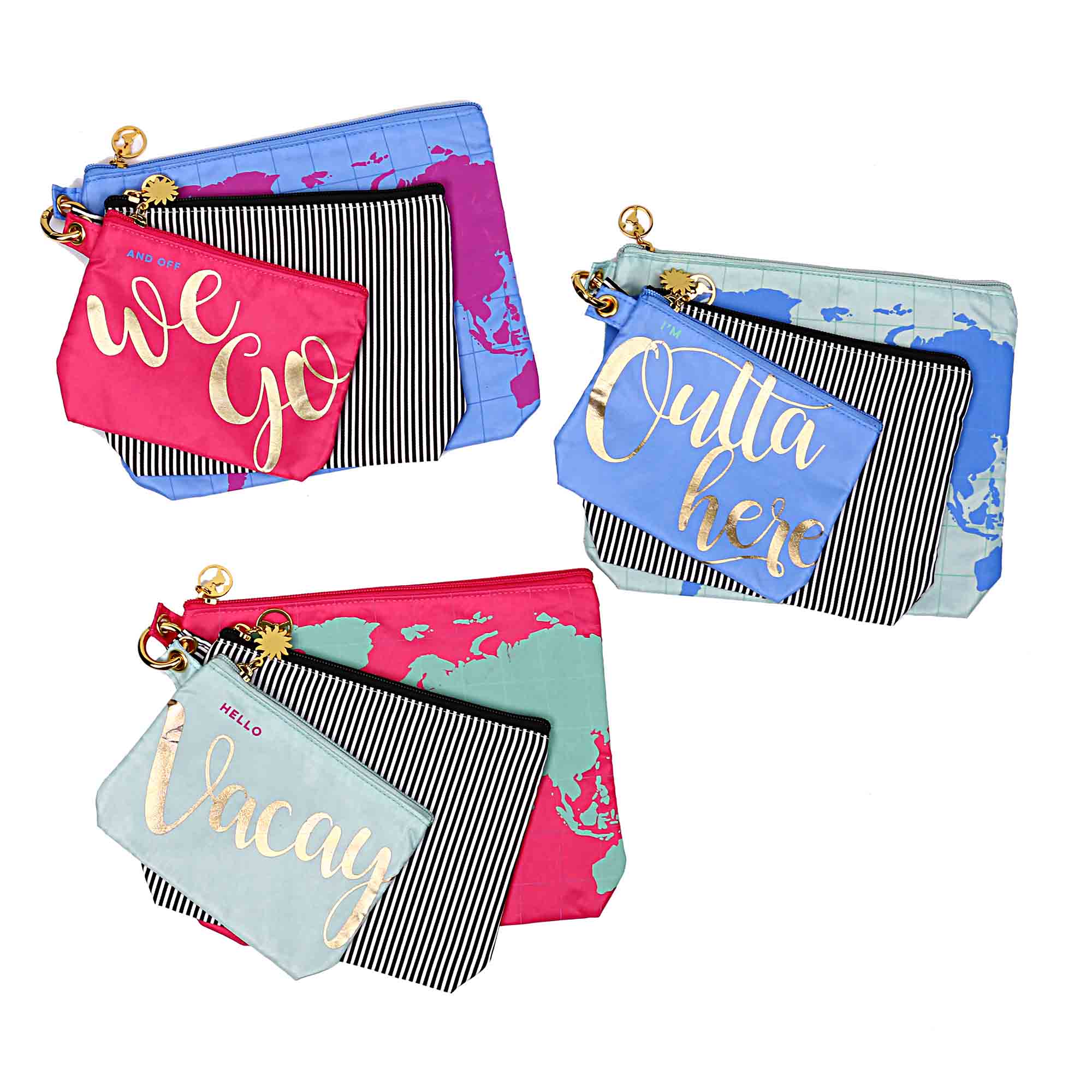
Flagship Launch Spotlight: Set of 3 Printed Multi-Purpose Pouches (Item 20211)
The ultimate launch vehicle for beauty brands developing custom printed makeup sets. This 3-piece nested collection provides three distinct functional sizes, allowing your brand to bundle full-size bottles, compact makeup palettes, and small beauty tools in a cohesive, luxury presentation.
| Nested Size Architecture | Large: W27.5 × D2.5 × H19.5cm | Medium: W22.5 × D2.5 × H16cm | Small: W18 × D2.5 × H12.5cm |
| Base Textile Material | High-tenacity, wear-resistant woven polyester engineered for sharp print clarity and wipe-clean maintenance |
| Custom Print Execution | Full-coverage High-Definition Digital Print or specialized Glitter Print across all exterior panels |
| Agile Sourcing Baseline | Low MOQ of only 100 Sets (Packed 12 sets per inner carton; total order flexibility) |
| OEM100 Program Agility | Order as shown, select curated patterns, or submit your own bespoke artwork, logo, and brand tags |
| Primary Target Uses | Skincare routine bundles, seasonal holiday gift sets, travel luggage organizers, and VIP influencer drops |
Founder’s Sourcing Advice: Stop forcing your customers to choose between carrying only a lipstick or an oversized tote. Order the production-ready Set of 3 Printed Multi-Purpose Pouches directly, discover our broader collection of giftable cosmetic bag sets, or review the complete mechanics of our dedicated OEM cosmetic bag program.
Direct Technical Comparison: Manufacturing Methods for Cosmetic Pouches
| Production Vector | Agile Low MOQ OEM (Printembroiderybags Model) | High-Volume Traditional Factory (Overseas Mass Scale) | Promotional Blank Imprinter (Domestic Swag Decorator) |
|---|---|---|---|
| Minimum Order Quantity (MOQ) | 100 pieces / sets per design | 3,000 to 5,000 pieces per style | 50 to 250 pieces (Pre-made stock) |
| Initial Capital Commitment | $800 – $2,500 total outlay | $15,000 – $40,000+ per order | $600 – $1,500 total outlay |
| Printing & Artwork Coverage | Full-bleed 100% panel coverage via digital print | Full-bleed via rotary screen (High screen fees) | Restricted 4″x4″ centered chest print only |
| Custom Dimensions & Geometry | Fully customizable cut-and-sew patterns | Fully customizable cut-and-sew patterns | Zero (Locked to generic catalog blanks) |
| Lining & Hardware Customization | Custom pullers, matched zippers, lined pockets | Custom metal dies, branded jacquard linings | Zero (Stock nylon coil zippers, raw unlined interior) |
| Production Lead Time | 15 to 20 business days | 8 to 14 weeks (Plus ocean shipping) | 5 to 10 business days |
| Best Operational Use Case | Indie beauty launches, seasonal drops, PR kits | Global mass-market supermarket distribution | Cheap corporate event employee giveaways |
Pros and Cons: Low MOQ Production vs. Volume Overseas Sourcing
| Sourcing Methodology | Documented Commercial Advantages (Pros) | Real-World Operational Liabilities (Cons) |
|---|---|---|
| Low MOQ Production (100 to 500 Pieces per Design) | Preserves 80% to 90% of early-stage working capital. Compresses product launch lead times to under 30 days. Allows simultaneous testing of multiple print aesthetics. Eliminates warehouse dead-stock inventory holding fees. Enables highly targeted limited-edition seasonal drops. | Unit cost per piece is 15% to 30% higher than mass 10,000-unit runs. Cannot justify custom-cast metal zipper puller molds for small runs. Requires re-ordering planning if a viral drop sells out rapidly. |
| High-Volume Mass Sourcing (3,000 to 10,000+ Pieces per Design) | Lowest theoretical cost per unit on paper. Allows custom-woven textile weaves and custom-dyed yarns. Economical for multi-thousand retail store distributions. | Freezes tens of thousands of dollars in early cash flow. Massive risk of dead inventory if the design underperforms. Long 3 to 4-month lead times prevent agile reaction to market trends. High vulnerability to ocean freight port congestion delays. |
Commercial Realities: Unit Cost vs. Working Capital Velocity
The single most destructive financial error an indie beauty brand founder can make during procurement is falling into the unit cost trap. Novice founders look at a quotation spreadsheet and obsess over a two-dollar unit cost difference: an overseas mass-volume factory quotes $4.50 per cosmetic bag at a 5,000-piece minimum, while an agile low MOQ specialist quotes $7.50 per bag at a 200-piece minimum. The founder calculates on paper: “If I buy 5,000 bags, I save $3.00 per bag!”
In the real world of commercial retail operations, that calculation is fundamentally flawed. Consider the authentic cash-flow reality:
The 5,000-Piece “Cheap Unit Cost” Trap:
- The founder transfers $22,500 in upfront cash to the mass-production factory, plus $3,500 in ocean container freight and customs brokerage fees ($26,000 total cash outlay).
- The bags arrive twelve weeks later. During the initial six-month launch, the brand sells 600 cosmetic bags alongside its skincare products. Total gross revenue generated: $15,000.
- The founder now has 4,400 cosmetic bags taking up four standard pallets in a 3PL logistics warehouse. At an average storage rate of $45 per pallet per month, the brand bleeds over $2,100 annually in pure dead-stock storage fees.
- Worse, $19,800 of the brand’s original cash is physically trapped in unsold canvas. When the brand needs $8,000 to re-formulate an active serum or pay for influencer marketing, the money is gone. The business stalls due to a cash-flow crunch, even though the unit cost looked cheap on paper.
The 200-Piece Low MOQ Investment:
- The founder transfers $1,500 to an agile Low MOQ Cosmetic Bag Production partner, with goods delivered via express air courier in three weeks ($1,800 total outlay).
- The brand sells out all 200 units within forty-five days, generating $5,000 in gross revenue and netting a clean $3,200 in operating profit.
- The brand carries zero pallet storage fees, has zero dead stock, and retains over $24,000 of liquid cash in its bank account to fuel product growth and digital advertising.
- Having proven that customers love the design, the founder places a re-order of 500 units, smoothly stepping up volume as real consumer demand scales.
Working capital velocity and cash preservation always beat paper unit cost discounts during the first two years of a beauty brand’s existence. For deeper commercial procurement analysis across Western and Asian supplier networks, consult our industry evaluation of cosmetic bag manufacturers USA Canada UK.
Who Should Use Low MOQ Production vs. Who Needs Mass Manufacturing
Every commercial hardware or packaging expenditure must match your business model, customer acquisition velocity, and distribution channels. Understanding where Low MOQ Cosmetic Bag Production excels versus where mass-volume production is required prevents expensive strategic mistakes.
Brands That Must Deploy Low MOQ Cosmetic Bag Production:
- Indie Skincare, Makeup & Wellness Startups: Brands in their first one to three years of operation launching flagship cosmetic lines, skincare bundles, or holiday collections who need professional packaging without draining seed capital.
- Direct-to-Consumer (DTC) Brands Testing Seasonal Collections: Established beauty labels that want to drop dynamic quarterly capsule prints (e.g., Valentine’s Day pinks, summer coastal pastels, holiday metallics) without committing to massive multi-thousand inventory backlogs.
- Boutique Spas, Luxury Salons & Medical Aesthetics Clinics: High-end aesthetic practices that want to merchandise bespoke, private-label cosmetic travel kits for their clinical patients, where total annual volume ranges between 200 and 1,000 units.
- Influencer Brands & Brand Collaboration Drops: Content creators launching limited-edition beauty drops where scarcity and speed to market drive viral conversion.
When High-Volume Mass Manufacturing (3,000+ Pieces) Is Justified:
- National Big-Box Retail Distribution: If your brand has secured purchase orders to place cosmetic gift sets across 1,500 target retail doors (such as Sephora, Ulta, or Target), you require the monumental automated output of mass production to meet purchase order ship windows.
- Evergreen Core Packaging for Mature Conglomerates: If your brand has sold the exact same black nylon cosmetic pouch for five consecutive years with predictable replenishment sales of 10,000 units per month, scaling into massive sea-freight container runs maximizes gross margin efficiency. When you are ready to transition into high-volume bespoke architecture, explore our comprehensive full OEM cosmetic bag development division.
5 Costly Mistakes Beauty Brands Make When Sourcing Cosmetic Bags
Factory Floor Advisory: The “Unlined White Canvas” Disaster
The most common quality disaster in early-stage cosmetic bag sourcing is ordering unlined light-colored canvas or raw cotton pouches. When a consumer places a liquid foundation, a pressed powder compact, or an oil-based lip gloss inside an unlined bag, accidental spills are inevitable. In an unlined cotton bag, spilled foundation soaks directly through the fabric fibers, permanently staining the outside of the pouch and ruining the customer’s expensive leather handbag. Always mandate a wipe-clean, water-resistant interior lining—such as high-density 210D polyester or smooth nylon taffeta—with sealed internal binding along all seams.
- Falling for “Cheap Zipper” Traps: Specifying low-grade generic nylon coil zippers to save fifteen cents per bag. In consumer testing, the zipper is the primary mechanical failure point of any pouch. A zipper that catches on internal fabric seams, splits teeth under moderate packing pressure, or has a cheap zinc puller that snaps off under thumb tension leads directly to angry one-star product reviews. Insist on reinforced #5 nylon coil or smooth metal-tooth zippers paired with high-tensile cast pullers.
- Neglecting Cosmetic Chemical Resistance: Sourcing exterior fabrics that degrade when exposed to alcohol, essential oils, or sunscreen lotions. Many low-grade PVC laminates cloud, bubble, or become sticky when in contact with cosmetic chemical vapors. Ensure your manufacturing partner uses certified colorfast, chemically stable textiles that comply with international safety directives.
- Failing to Verify Interior Seam Overlocking: Accepting bags with raw, exposed fabric edges on the inside of the pouch. Un-bound internal seams fray rapidly as makeup brushes and tweezers scrape against them, filling the bag with loose textile threads that catch in zipper teeth. Quality bags demand fully bound, double-stitched grosgrain tape or polyester tape overlocking along every internal raw edge.
- Overlooking Textile Heavy Metal and Phthalate Compliance: Sourcing plasticized PVC or synthetic leather bags from unverified brokers without verifying toxic chemical compliance. In the United States and Europe, consumer packaging is strictly regulated under U.S. Consumer Product Safety Commission (CPSC) Guidelines for Phthalates and Lead and European REACH directives. Importing bags containing banned ortho-phthalates can lead to total customs confiscation and severe federal fines.
- Ordering Without a Physical Pre-Production Sample: Approving mass production based entirely on a digital mockup on a computer monitor. Digital screens emit RGB light; printed textiles absorb ambient light via CMYK pigments. Texture, zipper gliding smoothness, internal lining drape, and true color saturation can only be evaluated by holding a physical, sewn prototype in your hands.
Essential Sourcing Checklist: Auditing a Low MOQ Cosmetic Bag Factory
Before transferring production deposits or issuing purchase orders for Low MOQ Cosmetic Bag Production, require prospective manufacturers to prove compliance across these four non-negotiable operational benchmarks:
1. Verified Cut-and-Sew Infrastructure and In-House Printing
Ensure that your supplier is an actual manufacturing factory rather than an unlicensed middleman broker:
- Do they operate automated computerized cutting tables capable of holding millimeter-accurate pattern tolerances across stacked fabric plies?
- Do they house direct industrial digital sublimation or UV printing machinery in-house, or do they subcontract printing to a separate facility, adding weeks to lead times?
- Learn how to audit prospective facilities by reviewing our comprehensive how to choose a cosmetic bag manufacturer guide and our actionable cosmetic bag supplier audit checklist.
2. Certified Textile Testing and Environmental Standards
Audit the factory’s raw material supply chain:
- Are all synthetic and natural textiles certified under OEKO-TEX Standard 100, verifying that fabrics are free from harmful levels of over 100 toxic chemicals, allergens, and carcinogens?
- Do organic cotton or recycled polyester options carry verified chain-of-custody documentation under the Global Recycled Standard (GRS) or Global Organic Textile Standard (GOTS)? Review sustainable sourcing strategies in our deep dive on sustainable cosmetic bag materials.
3. Physical Hardware and Mechanical Stress Standards
Inspect the mechanical components:
- Zippers must withstand rigorous tensile cross-pull testing exceeding standards established by ASTM International: Standard Test Methods for Strength Tests of Zippers (ASTM D2061).
- Top handles, wristlet straps, and zipper pullers must withstand a minimum static pull-test of at least 15 to 25 pounds (6.8 to 11.3 kg) without seam tearing or rivet pull-out.
- For luxury leather options, inspect specialized craftsmanship requirements in our technical review of genuine leather cosmetic bags.
4. Total Manufacturing Transparency and Rapid Quoting
A high-competence manufacturing partner provides clear, transparent cost breakdowns without hidden setup fees. Settle for nothing less than dedicated engineering support that answers technical questions quickly, provides clear CAD templates, and delivers fast, itemized pricing. Request customized production numbers on our direct custom cosmetic bag quote portal, inspect our complete cosmetic bag manufacturing capabilities, and read practical industry updates on our cosmetic bag manufacturing blog.
Expert Procurement Verdict: The Fast-Launch Roadmap
In our professional assessment across decades of textile engineering and cosmetic packaging production, the verdict is definitive: committing to multi-thousand-piece factory minimums before proving product-market fit is the single most dangerous mistake an indie beauty brand can make. Sourcing custom pouches is no longer an all-or-nothing proposition. Modern Low MOQ Cosmetic Bag Production gives emerging brands the exact same high-definition digital printing, bespoke hardware, and luxury finishes enjoyed by legacy conglomerates, without the crushing capital liability.
Here is your clear, actionable go-to-market roadmap:
- Standardize on a Multi-Functional Nested Set for Launch: Do not launch with a single flat pouch. Deploy a tiered set like the Set of 3 Printed Multi-Purpose Pouches (Item 20211). You provide your customer with a complete travel organization system (large for bottles, medium for compacts, small for lipsticks and brushes) while tripling the perceived luxury value of your skincare routine bundles.
- Keep Initial Production Runs to 100 to 300 Sets: Preserve your seed capital. Invest your cash where it matters most: into high-conversion digital advertising, clinical formulation testing, and influencer gifting campaigns.
- Mandate Full-Bleed Digital Printing and Wipe-Clean Linings: Never settle for plain promotional blanks. Ensure your exterior artwork is printed edge-to-edge with crisp Pantone matching, and mandate high-density water-resistant internal linings that protect against accidental spills.
- Partner with a Proven Agile Specialist: Eliminate brokers and trading intermediaries by partnering directly with Printembroiderybags. Through our innovative OEM100 Program, our factory delivers bespoke, retail-ready cosmetic bags starting at just 100 pieces per design with 15-to-20-day production turnarounds, allowing your beauty brand to launch faster, operate leaner, and scale profitability from your very first customer drop.
Frequently Asked Questions
Why is low MOQ cosmetic bag production critical for new beauty startups?
Low MOQ cosmetic bag production allows emerging beauty brands to launch custom makeup pouches and retail gift-with-purchase sets without tying up tens of thousands of dollars in unsold inventory. Starting with 100 pieces per design reduces upfront working capital risk, compresses factory lead times to two to three weeks, and allows brands to test market demand before committing to mass manufacturing.
What can beauty brands customize with a 100-piece low MOQ cosmetic bag order?
With an agile low MOQ cosmetic bag production run, brands can customize exterior patterns via high-resolution all-over digital sublimation printing, select custom zipper pullers, add woven or silicone brand labels, match interior lining colors, and choose specialized fabric finishes such as water-resistant polyester, canvas, or soft-touch velvet.
How does low MOQ production impact the unit cost of custom cosmetic pouches?
Low MOQ cosmetic bag production incurs a modestly higher unit cost (typically 15% to 30% above 5,000-piece volume pricing) due to fixed digital setup and cutting labor. However, it delivers massive net capital savings by avoiding freight warehousing fees, dead-stock write-offs, and tied-up liquidity, resulting in a much healthier cash-flow profile for new brands.
How fast can a new beauty brand launch using low MOQ cosmetic bag manufacturing?
Traditional mass-production contracts require 8 to 16 weeks for custom fabric weaving, sample approvals, and sea freight. Agile low MOQ cosmetic bag production utilizes ready-stock textile bases and direct-to-fabric digital printing, enabling prototype approval in 3 to 5 days, full production in 15 to 20 days, and fast courier delivery, allowing brands to launch within four weeks.
Authoritative References & Textile Quality Standards
- OEKO-TEX Association: Standard 100 Certification Criteria for Harmful Substance Testing in Consumer Textiles
- U.S. Consumer Product Safety Commission (CPSC): Regulatory Requirements for Children’s Products, Phthalates, and Lead Limits in Synthetic Fabrics
- ASTM International: ASTM D2061 Standard Test Methods for Strength Tests of Zippers and Mechanical Fasteners