A custom cosmetic bag can leave the factory looking excellent and still arrive with crushed corners, scuffed decoration, moisture marks, or missing retail components. International shipping adds more handling, longer transit times, customs documentation, and destination-specific requirements. The right approach is to design packaging around the bag’s materials, construction, decoration, order quantity, and final sales channel—not simply put every unit in a carton and book the cheapest freight option.
Direct answer: how should you package and ship custom cosmetic bags internationally?
Protect each finished bag individually, keep decorative surfaces from rubbing against other products, use suitable moisture protection, pack units into strong export cartons, and secure the cartons for repeated handling. Before dispatch, confirm the product description, quantity, declared value, country of origin, HS classification, consignee details, and required commercial documents with your freight forwarder. For branded retail orders, also check barcode, label, insert, and presentation requirements before mass packing.
From our experience in custom bag development, the most reliable results come when packaging is specified during product development and approved with the sample. Treating export packing as a last-minute warehouse task is where avoidable damage and shipment delays begin.
Quick Answer
For most international wholesale orders, use an individual protective bag or sleeve for each cosmetic bag, add non-abrasive protection around hardware and decorated areas, and arrange units in a carton that prevents movement without excessive compression. Choose carton strength and internal packing according to the bag’s size, weight, structure, and route. Use a tracked courier for urgent samples or smaller shipments; compare air freight and sea freight for larger orders. Confirm customs requirements and shipping marks before the goods leave the factory.
Contents
- Why export packaging matters
- How to package cosmetic bags
- Packaging materials and methods
- Choosing an international shipping method
- Customs documents and declarations
- Packaging and shipping comparison
- Benefits and limitations
- Common mistakes to avoid
- Buyer and supplier checklist
- Expert recommendation
- Frequently asked questions
Why Packaging Matters When You Ship Custom Cosmetic Bags Internationally
Cosmetic bags are often lightweight, but that does not make them damage-proof. A soft pouch may tolerate normal handling, while a structured makeup case with a rigid base, metal zipper, embroidered logo, or shaped panels can be damaged by pressure and friction. A carton may also travel through several facilities before reaching the buyer, so the packaging needs to protect the product beyond the conditions of a short domestic delivery.
Packaging is part of the product experience, especially for private-label brands, promotional campaigns, gift sets, and retail collections. A buyer who opens a carton of wrinkled, dusty, or scratched bags may question the quality of the entire order—even if the sewing and materials meet the approved specification.
We recommend evaluating export packaging against four practical risks:
- Compression: Cartons stacked in transit can press down on soft or structured bags. Excessive pressure may deform padded panels, molded shapes, or rigid inserts.
- Friction: Zippers, metal pulls, coated fabrics, printed surfaces, and embroidery can rub against adjacent products. This is particularly important when bags are packed tightly together.
- Moisture and contamination: Long transit, warehouse storage, and handling conditions can expose cartons to humidity, condensation, dust, or surface contamination.
- Presentation damage: Creased labels, crushed gift boxes, displaced inserts, or tangled straps can make a retail-ready item look unsuitable for sale.
For a basic promotional pouch, a simple protective sleeve and well-sized carton may be sufficient. For a premium cosmetic case with custom embroidery, special hardware, or a gift-ready presentation, the packaging specification should be more detailed. See our packaging solutions for cosmetic bags when planning product protection and presentation together.
How to Package Custom Cosmetic Bags for International Shipping
The best packing sequence is straightforward: inspect, protect, organize, carton-pack, and verify. The exact materials will vary, but the sequence should remain consistent so that every unit receives the same protection.
1. Inspect the Finished Bags Before Packing
Do not use packaging to hide production defects. Before packing, check the approved sample or inspection standard for dimensions, stitching, zipper operation, lining, logo position, color, and cleanliness. Confirm that the correct labels, hangtags, inserts, and accessories are included.
For embroidered cosmetic bags, inspect raised threads and exposed backing. For printed cosmetic bags, check that the printed surface is dry and free from transfer marks before placing it against another surface. If a bag has metal hardware, confirm that pulls and decorative fittings are secured so they cannot scratch neighboring units.
In most professional situations, a simple documented pre-packing inspection is more valuable than adding expensive protective material after defects have already occurred.
2. Protect Each Cosmetic Bag Individually
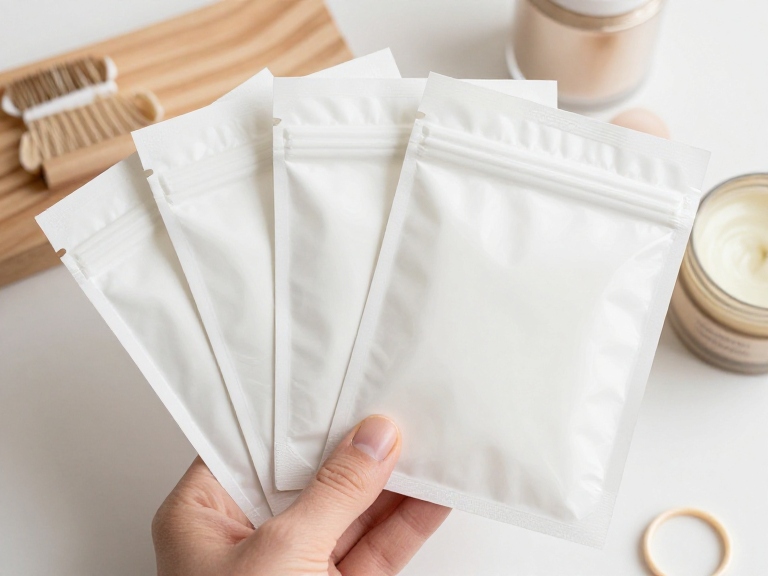
Use a suitable individual sleeve, polybag, tissue wrap, or non-abrasive protective layer. The right choice depends on the fabric, decoration, and retail requirements.
- Polyester and nylon bags: A clean protective sleeve can reduce dust and surface rubbing. Avoid packing products while damp.
- PU or coated materials: Use a compatible separator if surfaces may stick or transfer color under heat or pressure. Test the packaging against the material before mass production.
- Embroidered bags: Protect raised embroidery from snagging and friction. Avoid rough paper edges or loose components that can catch threads.
- Printed bags: Ensure the print is fully cured according to the production process before stacking or wrapping. Use a smooth separator where surface contact is a concern.
- Bags with metal hardware: Cover or position zipper pulls and fittings so they do not press into the bag body or scratch another unit.
Do not automatically choose the thickest plastic or the largest amount of bubble wrap. Extra packaging adds cost, volume, and waste. The objective is controlled protection, not unnecessary layers.
3. Arrange the Bag to Preserve Its Shape
Empty cosmetic bags can often be nested or folded, but only when the product construction allows it. Follow the approved packing method for the specific style. A structured case, padded pouch, or bag with a rigid base may need light internal support to prevent collapse.
For soft bags, use clean tissue or a suitable insert when it helps maintain the intended shape. Do not overfill the bag: excessive stuffing can stretch seams, distort panels, or place pressure on the zipper. For a flat pouch, keep folds consistent and avoid creating sharp creases across coated or printed areas.
4. Separate Units and Control Carton Movement
Place protected units in the export carton in an organized arrangement. Use dividers or separators when products have hardware, delicate decoration, or different sizes. The carton should be filled enough to limit movement, but not so tightly that the bags are compressed.
For larger orders, specify the number of units per inner pack and per master carton. Consistent carton quantities make receiving, stock counting, and warehouse allocation easier for international buyers. If the buyer needs individual retail packaging, define that requirement before production rather than asking the packing team to improvise at dispatch.
5. Seal, Label, and Check the Export Carton
Use a carton suitable for the packed weight and expected handling conditions. Close it securely with appropriate carton tape and apply shipping marks that match the packing list and buyer instructions. Marks commonly include the consignee or purchase order reference, carton number, gross weight, net weight, dimensions, and country of origin where required or requested.
Keep external labels legible and avoid placing tape across barcodes or important handling information. If the buyer uses warehouse labels, carton labels, or retailer-specific compliance labels, obtain the final artwork and placement instructions before packing begins.
Best Packaging Materials for Custom Cosmetic Bags
Packaging should match the product’s risk profile and commercial positioning. A low-cost drawstring pouch shipped in bulk does not need the same protection as a structured cosmetic case sold in a premium gift box.
| Packaging material | Best use | Main advantage | Watch out for |
|---|---|---|---|
| Individual polybag or protective sleeve | Most fabric cosmetic bags | Helps keep units clean and separated | Choose suitable dimensions and material; avoid trapping moisture |
| Tissue paper | Gift-ready or delicate products | Soft separation and presentation | Not a substitute for moisture protection or a strong carton |
| Bubble wrap or cushioning | Structured cases and vulnerable hardware | Helps absorb impact and reduce movement | Can increase carton volume and freight cost |
| Cardboard dividers | Mixed styles or hardware-heavy products | Separates units and organizes cartons | Can add weight and take up space |
| Corrugated export carton | Wholesale and bulk shipments | Provides outer protection and stacking structure | Strength must match carton weight and route |
| Retail gift box | Premium retail and gifting | Improves shelf and unboxing presentation | Needs additional protection against crushing in transit |
For a custom order, the most effective approach is to approve the packaging with the product sample. Our full OEM development service connects artwork, materials, construction, decoration, and final presentation. This matters because a change in bag dimensions, zipper hardware, or outer fabric can change the packing method too.
How to Choose an International Shipping Method
There is no single best shipping method for every cosmetic bag order. The right decision depends on order volume, delivery deadline, destination, carton dimensions, shipment value, and how much inventory risk the buyer can accept.
Express Courier: Best for Samples and Urgent Small Orders
Express courier services are useful for pre-production samples, approval samples, urgent replenishment, and relatively small cartons. They usually provide tracking and a simpler door-to-door process than arranging a full freight movement independently. However, the cost per unit can be high, particularly when cartons are bulky relative to their actual weight.
We recommend express shipping when speed and direct delivery are more important than minimizing freight cost. Before booking, compare the carrier’s chargeable weight with the actual carton weight. Dimensional weight can make a light but oversized carton surprisingly expensive.
Air Freight: Best for Time-Sensitive Wholesale Orders
Air freight can make sense for medium-sized wholesale orders when the buyer needs stock sooner than sea freight can deliver. It is generally faster than ocean transport, but total cost can include origin handling, export documentation, airport charges, destination handling, customs clearance, and final delivery.
Do not compare air freight and courier quotes using only the headline rate. Ask for a clear breakdown of the service scope, chargeable weight, customs handling, and destination charges. A low origin quote is not necessarily the lowest landed cost.
Sea Freight: Best for Larger, Planned Orders
For larger production runs with flexible delivery dates, sea freight can offer a more economical cost per unit. It is particularly relevant when the order is packed in multiple export cartons or consolidated with other cargo. The trade-off is a longer and less predictable end-to-end schedule, especially when port handling, customs clearance, and inland delivery are included.
For commercial users, we recommend planning backward from the required warehouse arrival date. Include production, inspection, packing, export handling, transit, customs clearance, and a reasonable contingency. Do not schedule retail launches around an optimistic port-to-port estimate alone.
Consolidated Freight: Useful for Smaller Wholesale Shipments
Less-than-container-load sea freight or consolidated air cargo may suit buyers who do not have enough volume to justify a dedicated shipment. Consolidation can reduce the need to pay for unused capacity, but it adds handling and may involve minimum charges or destination fees. Request a door-to-door or clearly itemized quote so you can compare the actual landed cost.
Customs Documents and Declarations for International Cosmetic Bag Shipments
Customs clearance is not an administrative detail to leave until the cartons are ready. Incorrect product descriptions, inconsistent quantities, or missing commercial information can delay a shipment and create extra costs for the buyer.
For a typical commercial export shipment, the buyer, supplier, and freight forwarder should confirm which documents are required for the origin and destination countries. Common documents include:
- Commercial invoice: Identifies the seller, buyer, product description, quantity, unit price, total value, currency, and other information required by the relevant customs authorities.
- Packing list: Shows carton count, packing details, quantities, gross and net weights, and carton dimensions.
- Air waybill or bill of lading: Transport document associated with the selected shipping method.
- Certificate of origin: Required in some circumstances or requested to support preferential tariff treatment or buyer procedures. Confirm the applicable rules rather than assuming it is always necessary.
- Additional destination-specific documents: These may apply depending on the destination, product materials, trade agreement, or import procedure.
Describe the goods accurately. For example, use a clear description such as “textile cosmetic bags with zipper” when that accurately reflects the product. Do not use vague descriptions such as “gift” or “accessories” when a more precise description is available. The correct HS classification depends on the product’s construction and material; do not copy a code from an unrelated bag listing.
Country-of-origin marking, textile labeling, and consumer product requirements may also apply in the destination market. These requirements are not identical worldwide. Ask the importer or a qualified customs broker to confirm the rules for the specific product and market before mass production.
Important: This article covers cosmetic bags as empty accessories. If a shipment contains cosmetics, liquids, aerosols, batteries, or other regulated contents, additional transport and import rules may apply. Do not assume that rules for an empty textile bag also cover products packed inside it.
For practical export preparation, review the carrier and customs guidance before dispatch. DHL’s international import and export advice is a useful starting point for understanding shipping and customs preparation.
Packaging and Shipping Comparison: Which Setup Should You Choose?
The following comparison is a practical starting point, not a universal specification. Final carton design and freight selection should be based on a packed sample, measured carton dimensions, destination, and buyer requirements.
| Order scenario | Recommended packaging | Shipping option to compare | Commercial priority |
|---|---|---|---|
| Pre-production sample | Individual sleeve, protective wrap, compact outer carton | Express courier | Fast feedback and sample protection |
| Small online-store launch | Individual protection, organized master carton, retail inserts if required | Express courier or consolidated air | Balance delivery speed and landed cost |
| Medium wholesale order | Consistent inner packs, dividers where needed, export cartons | Air freight or consolidated sea freight | Predictable replenishment and carton efficiency |
| Large seasonal order | Approved bulk-packing specification and pallet plan where applicable | Sea freight, subject to schedule | Lower freight cost per unit and delivery planning |
| Premium gift collection | Retail box or presentation sleeve plus protective master-carton packing | Courier, air, or sea based on volume | Protect retail appearance without overspending |
| Embroidered or hardware-heavy bags | Non-abrasive individual protection and separation between units | Any suitable mode with robust outer packing | Prevent snagging, rubbing, and surface damage |
Quick Summary Table
| Decision | Our recommendation | Why it matters |
|---|---|---|
| Individual protection | Use a sleeve or suitable wrap for each unit | Reduces dust, rubbing, and handling marks |
| Shape protection | Use light support only where construction requires it | Prevents deformation without overstuffing |
| Carton selection | Match carton strength to packed weight and route | Controls crushing and handling damage |
| Freight selection | Compare courier, air, and sea on total landed cost | Avoids choosing by headline freight rate alone |
| Customs preparation | Confirm classification and documents before dispatch | Reduces clearance errors and avoidable delays |
| Retail presentation | Approve labels, inserts, and gift packaging before production | Protects brand consistency at delivery |
Benefits and Limitations of a Proper Export Packaging Plan
A defined packaging specification improves consistency, but it does not eliminate every shipping risk. It should be treated as one part of an export quality process that also includes production inspection, freight planning, and accurate documentation.
Benefits
- Fewer preventable product issues: Individual protection and carton organization reduce common sources of surface damage, dust, and deformation.
- More consistent receiving: Standard carton quantities and clear labels make warehouse counting and stock intake easier.
- Better retail presentation: Approved inserts, labels, and protective packaging help products arrive closer to the intended unboxing experience.
- More predictable freight planning: Measuring packed cartons early helps buyers compare shipping methods using realistic dimensions and weights.
- Stronger supplier accountability: A written packing specification makes it easier to identify whether the agreed method was followed.
Limitations
- Additional material and labor cost: Individual wrapping, dividers, gift boxes, and special labels can increase packing costs.
- More packaging volume: Protective inserts and oversized cartons may increase dimensional weight or freight space.
- No guarantee against all damage: Severe mishandling, water exposure, or unsuitable storage can still damage goods.
- Market-specific compliance: Packaging and labeling accepted in one country may not satisfy another market’s requirements.
Pros vs. Cons Table
| Pros | Cons |
|---|---|
| Protects decorated surfaces and hardware when correctly specified | Requires product-specific testing and packing instructions |
| Improves carton organization and receiving efficiency | May increase packing labor and material costs |
| Supports premium retail presentation | Gift boxes can increase shipping volume significantly |
| Helps buyers compare freight using actual packed dimensions | Does not remove customs, carrier, or transit risks |
| Creates a repeatable standard for future orders | Needs updating when product design or destination requirements change |
Common Mistakes When Packaging and Shipping Cosmetic Bags Internationally
Using One Packing Method for Every Bag Style
A flat cotton pouch, a padded nylon makeup case, and a structured cosmetic organizer do not have identical protection needs. A single packing instruction may be convenient, but it can either under-protect delicate products or add unnecessary cost to simple ones. Specify packing by product style or construction group.
Overpacking the Carton
Filling every gap by force can crush the products and distort their shape. A carton should limit movement while allowing the bags to sit naturally. If the carton only closes when workers press down hard, the packing configuration needs to be reviewed.
Ignoring Dimensional Weight
Cosmetic bags are often light relative to their carton size. A large carton filled with loosely arranged pouches can cost more to ship than a compact, well-organized carton. Measure the final packed carton, not an estimated product size, before requesting a freight quote.
Leaving Retail Packaging Until the Last Minute
Hangtags, barcode labels, care labels, inserts, and gift boxes affect packing time and carton dimensions. Confirm these items during sampling. Late changes can create rework, delay dispatch, or lead to inconsistent retail presentation.
Using Inaccurate Customs Descriptions
Do not understate value or describe commercial goods inaccurately to reduce duties. Ensure the invoice and packing list agree on the product description, quantity, weights, and shipment details. The importer should confirm classification and destination-specific requirements with a customs professional.
Choosing the Cheapest Freight Quote Without Checking Its Scope
A quote may exclude destination handling, customs clearance, delivery, or other charges. Compare the complete service and estimated landed cost. For a seasonal launch, the cost of a missed delivery window may be much greater than the apparent freight saving.
International Shipping Checklist for Cosmetic Bag Buyers and Suppliers
Before approving mass packing, buyers should send a written checklist to the manufacturer and freight partner. This is especially important when several styles, colors, or packaging versions are included in one purchase order.
Product and quality
- Approved sample and final product specifications are confirmed.
- Logo, embroidery, print, color, stitching, and hardware have passed inspection.
- Products are clean and dry before packing.
- Folding, stuffing, and nesting methods are approved for each style.
Packaging and carton
- Individual protection is suitable for the fabric and decoration.
- Retail labels, barcodes, inserts, and gift boxes are confirmed.
- Units per inner pack and master carton are documented.
- Carton dimensions, gross weight, and net weight are measured.
- Carton strength and closure method suit the packed shipment.
- Shipping marks and carton numbering match buyer instructions.
Freight and customs
- Destination address and consignee details are verified.
- Shipping method and required delivery date are agreed.
- Commercial invoice and packing list are checked for consistency.
- HS classification, origin marking, and import requirements are confirmed.
- Freight quote scope, destination charges, and insurance options are reviewed.
- Tracking, document handover, and delivery responsibilities are assigned.
For brands ordering multiple styles or developing a new range, the Custom Cosmetic Bags OEM100 program can be considered as part of a planned product-development process. Buyers can also review the broader custom cosmetic bag product range and the manufacturing capabilities before finalizing a specification.
Cost-Benefit Analysis: Where Should You Spend More on Packaging?
Not every cosmetic bag needs premium packaging. The most cost-effective solution is the one that protects the product and meets the buyer’s presentation requirements without adding avoidable weight, volume, or labor.
For basic promotional bags, prioritize clean individual protection, efficient carton dimensions, and accurate documentation. Spending heavily on gift boxes is unlikely to create value if the buyer distributes the bags as event merchandise.
For a premium retail collection, it may be worth investing in printed sleeves, tissue, branded inserts, or individual boxes. However, test the complete retail pack inside the export carton. A beautiful gift box that arrives crushed is not a successful packaging solution.
For large wholesale orders, carton optimization often deserves more attention than decorative outer packaging. A modest reduction in carton dimensions, when achieved without compressing the products, can improve freight efficiency across the entire order. Ask the supplier to provide the packed dimensions and weight for the proposed configuration before confirming the shipping budget.
For more specialized product lines, explore custom embroidery cosmetic bags and custom printing cosmetic bags. Decoration methods influence the protection needed during packing, so they should be considered before the final export specification is approved.
Who Should Use a Formal Cosmetic Bag Export Packaging Plan?
Retail Brands and Private-Label Buyers
Brands selling through retail stores or their own online shops should define individual packaging, barcode placement, labels, and presentation requirements before production. A consistent unboxing experience matters when customers receive products from different batches or distribution centers.
Wholesale Importers and Distributors
Importers handling cartons in warehouses should prioritize carton strength, standard quantities, clear shipping marks, and easy counting. These details can save receiving time and reduce disputes about shortages or mixed assortments.
Promotional Product Buyers
For event giveaways and corporate merchandise, efficient bulk packing is usually more valuable than elaborate retail packaging. Confirm whether the bags will be handed out individually or stored and distributed later, then choose protection accordingly.
Who Does Not Need Premium Individual Packaging?
Buyers of simple, low-cost bags for bulk distribution may not need individual gift boxes or multiple protective layers. If the product has no delicate decoration, no retail presentation requirement, and a straightforward distribution plan, a clean protective sleeve and suitable export carton may be enough. Paying for packaging that the end customer immediately discards is not a sound commercial decision.
Expert Recommendation: Build Shipping Requirements Into the OEM Process
Our recommendation is to treat export packaging as part of the product specification—not as a separate task after manufacturing. This is the most reliable way to avoid mismatches between the approved sample, finished goods, carton dimensions, and buyer expectations.
From our experience, the strongest process has five checkpoints:
- During design: Identify delicate surfaces, hardware, structure, retail packaging, and destination-market requirements.
- During sampling: Test the proposed individual protection and carton arrangement with a finished sample.
- Before mass production: Approve labels, inserts, barcode positions, carton quantities, and packing instructions.
- Before dispatch: Inspect finished goods, verify carton measurements, and check export documents.
- After delivery: Record damage, carton condition, and buyer feedback to improve the next shipment.
PrinteMbroideryBag supports brands developing custom cosmetic bags from artwork and material selection through sampling, production, and packaging coordination. For buyers who need more than a standard catalog item, full OEM cosmetic bag development provides a route to align product construction and final presentation. You can also learn more about the industries PrinteMbroideryBag serves and the company’s manufacturing background.
For a new international order, we recommend requesting a packing specification and a freight-ready carton estimate before approving production. That small step gives buyers a clearer view of the landed cost and reduces the chance of discovering packaging problems after the goods are finished.
Frequently Asked Questions About Packaging and Shipping Custom Cosmetic Bags
1. What is the best way to package cosmetic bags for international shipping?
Protect each bag individually with a suitable sleeve, polybag, or non-abrasive wrap. Separate products with delicate decoration or hardware, arrange them without excessive compression, and use an export carton suited to the packed weight and shipping route. The final method should be approved with a packed sample.
2. Should every custom cosmetic bag be packed in a separate polybag?
Not necessarily, but individual protection is a practical choice for many wholesale orders because it helps keep products clean and reduces rubbing. For premium retail products, tissue, a branded sleeve, or a presentation box may be more appropriate. Confirm material compatibility and destination-market packaging requirements.
3. How do I prevent embroidered cosmetic bags from being damaged in transit?
Use a smooth protective layer that will not catch raised threads, keep rough carton edges away from the embroidery, and prevent hardware from rubbing against decorated surfaces. Make sure the embroidery is inspected before packing and that the approved packing method is followed consistently.
4. Is air freight or sea freight better for wholesale cosmetic bags?
Air freight is worth comparing when delivery speed is important or the order is relatively small. Sea freight is often more economical for larger planned shipments with flexible delivery dates. Compare the complete landed cost, including handling, customs, and final delivery, rather than the transport rate alone.
5. What documents are needed to ship cosmetic bags internationally?
Common documents include a commercial invoice, packing list, and the relevant transport document, such as an air waybill or bill of lading. A certificate of origin or additional documents may be required depending on the destination and trade arrangement. Confirm the exact requirements with the importer or customs broker.
6. How should cosmetic bags be described on a commercial invoice?
Use a clear and accurate description that reflects the actual product, such as “textile cosmetic bags with zipper” when appropriate. Include the correct quantity, value, currency, seller and buyer details, and other information required by the destination customs authority. Avoid vague or misleading descriptions.
7. Can cosmetic bags be folded or nested to reduce shipping costs?
Yes, if the material and construction can tolerate the method without permanent creasing, deformation, or damage to decoration. Soft pouches are often easier to nest than structured cases. Test the packing arrangement with a finished sample before applying it to the full order.
8. How can I reduce international shipping costs for cosmetic bags?
Measure the final packed cartons, avoid oversized packaging, use consistent carton quantities, and compare courier, air, and sea options based on total landed cost. Do not reduce protection to the point that products arrive damaged; replacement costs and customer complaints can outweigh freight savings.
9. Do custom cosmetic bags need country-of-origin labels?
Origin-marking requirements depend on the destination market, product category, and applicable customs rules. Some markets also have textile labeling or consumer information requirements. Confirm the applicable rules with the importer or a qualified customs professional before production.
10. When should packaging requirements be confirmed with the manufacturer?
Confirm them during product development and sampling, before mass production. This gives the manufacturer time to test materials, prepare labels and inserts, calculate carton dimensions, and align packing with the buyer’s warehouse or retail requirements.
References
- DHL — International Import and Export Advice. Guidance on international shipping preparation and export processes.
- International Trade Administration — Export Solutions. U.S. government resources for exporters, documentation, and international trade planning.
- U.S. Customs and Border Protection — Basic Importing and Exporting. Official guidance on customs processes and import/export responsibilities.
Shipping, customs, origin-marking, and labeling requirements vary by destination and can change. Confirm the current rules with the relevant customs authority, carrier, importer, or licensed customs broker before dispatch.